Author
What purpose does the book state? What concerns and vocabulary recur?
Read within the setting
The foundation and the method
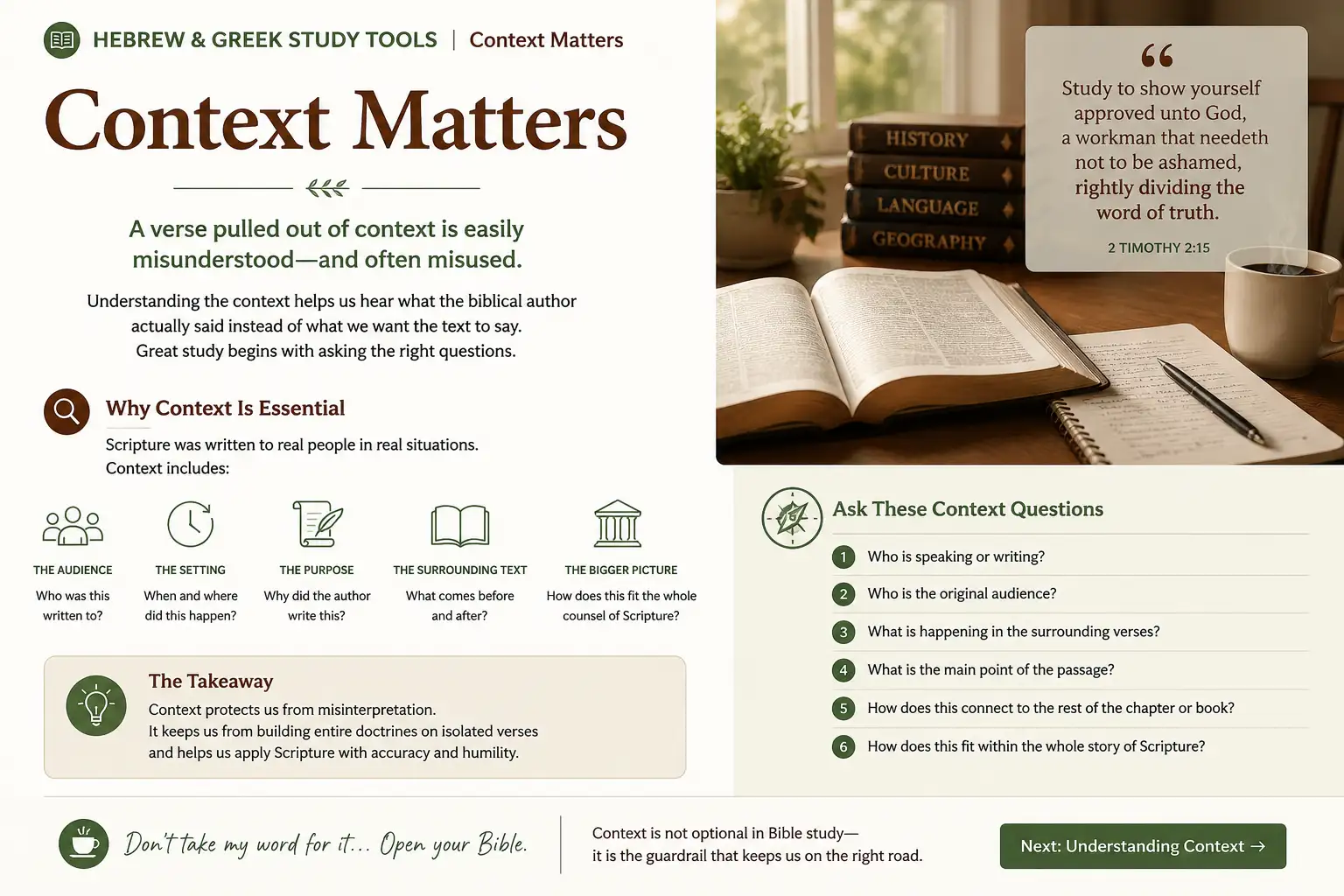
Context Matters introduces why isolated verses are so easily misused. This page is the deeper companion: it gives you a repeatable way to locate the contexts that shape meaning.
We are not hunting for background trivia to make a simple passage sound complicated. We are learning to hear an author’s words as the original audience would have heard them—inside a sentence, argument, book, historical moment, covenant setting, and the whole witness of Scripture.
Begin close, then widen
Start with the nearest context because it usually gives the most immediate control over meaning. Then widen the circle when the text itself sends you outward.
Circle one
Read the sentences before and after the verse. Identify pronouns, repeated words, contrasts, reasons, commands, questions, and conclusions. Ask what “therefore,” “for,” “but,” or “so that” is connecting.
Follow the thought
Literary context asks how a sentence functions within the paragraph, section, chapter, and complete book. A promise in a lament, a line in a parable, and a command in a covenant speech must be read according to the kind of writing they belong to.
Chapter and verse numbers are navigation tools added long after the biblical books were written. They do not always mark the beginning or end of an author’s complete thought.
Enter their world
Identify the time, place, customs, political pressures, religious practices, and major events that the passage assumes. Good background information illuminates details already present in the text; it does not replace the text with an imaginative story.
Listen to the conversation
What purpose does the book state? What concerns and vocabulary recur?
What did they know, fear, misunderstand, or need to obey?
Was this written during crisis, exile, worship, instruction, conflict, or mission?
Read what is actually there
Describes what happened. Not every action is an approved pattern or direct command.
Uses imagery, parallelism, compressed language, and general principles that require careful reading.
Addresses real covenant circumstances while sometimes reaching toward later fulfillment.
Develop connected arguments and apply truth to particular assemblies and situations.
Read commands within their covenant, audience, purpose, and relationship to the rest of Scripture.
Uses symbols and visions rooted in earlier Scripture. Do not assign meanings by imagination alone.
Locate the covenant setting
Ask where the passage sits in the unfolding biblical story: creation, the patriarchs, Sinai, the land, kingdom, exile, return, the coming of Yeshua, the new covenant, and the promised restoration of all things.
Earlier Scripture is not disposable. Yeshua and the apostles repeatedly teach from Torah, the Prophets, and the Writings. Covenant context helps us identify the original audience and covenant setting, trace promise and fulfillment, and carefully distinguish continuity from change—without flattening the whole Bible into one moment.
Words live in sentences
Hebrew and Greek tools can reveal vocabulary, grammar, idioms, and repeated roots. But a lexicon lists possible meanings; the sentence and passage determine which meaning is functioning here. A Strong’s number is an index, not a tiny inspired sermon.
Study Hebrew & Greek responsibly →The whole counsel of Scripture
After hearing a passage inside its own book, compare it with the rest of Scripture. Clear passages can help with difficult ones; later writers may quote or explain earlier texts; repeated themes may show development across the biblical story.
Canonical context is not permission to cancel one passage with another. It is the disciplined work of allowing all of Scripture to speak truthfully together.
These pages are related—not interchangeable
The introductory teaching that explains why isolated verses are dangerous.
Open the teaching →The deeper method for finding literary, historical, audience, genre, covenant, and canonical context.
Open this resource →The practical geography and chronology tools that locate people and events in the real world.
Open this resource →The language tools for investigating words and grammar without ignoring the passage.
Open this resource →The method for following quotations, echoes, parallel accounts, shared events, and themes.
Open this resource →Philippians 4:13 is often treated as a promise of unlimited achievement. The immediate paragraph discusses Paul’s learned contentment through abundance and need while he thanks the Philippians for their partnership.
Verses 10–12 name hunger, plenty, abundance, and need.
“All things” refers to the changing circumstances Paul has just described—not every goal a reader can imagine.
The verse still offers deep hope: Paul testifies that Messiah strengthens him for faithful contentment and endurance in both provision and hardship. Believers may receive that encouragement without turning the verse into a promise of unlimited achievement.
Slow down here
A verse number may interrupt a sentence or argument. Keep reading until the thought is complete.
If a historical claim cannot be verified or does not clarify something in the text, hold it loosely.
Proverbs, parables, narrative, covenant instruction, letters, and apocalyptic visions do not communicate in identical ways.
Faithful application begins after we understand what the author communicated to the original audience.
Your turn