AI can help you
- Generate questions and create study plans
- Locate possible cross-references
- Explain terminology
- Organize observations
- Compare interpretive approaches
Bible Study Toolbox
You do not need to know everything before you begin.
Good Bible study starts with slowing down, asking better questions, reading passages in context, and learning how to use a few reliable tools well.
This Toolbox is designed to help you build those skills one at a time.
Choose Your Next Skill
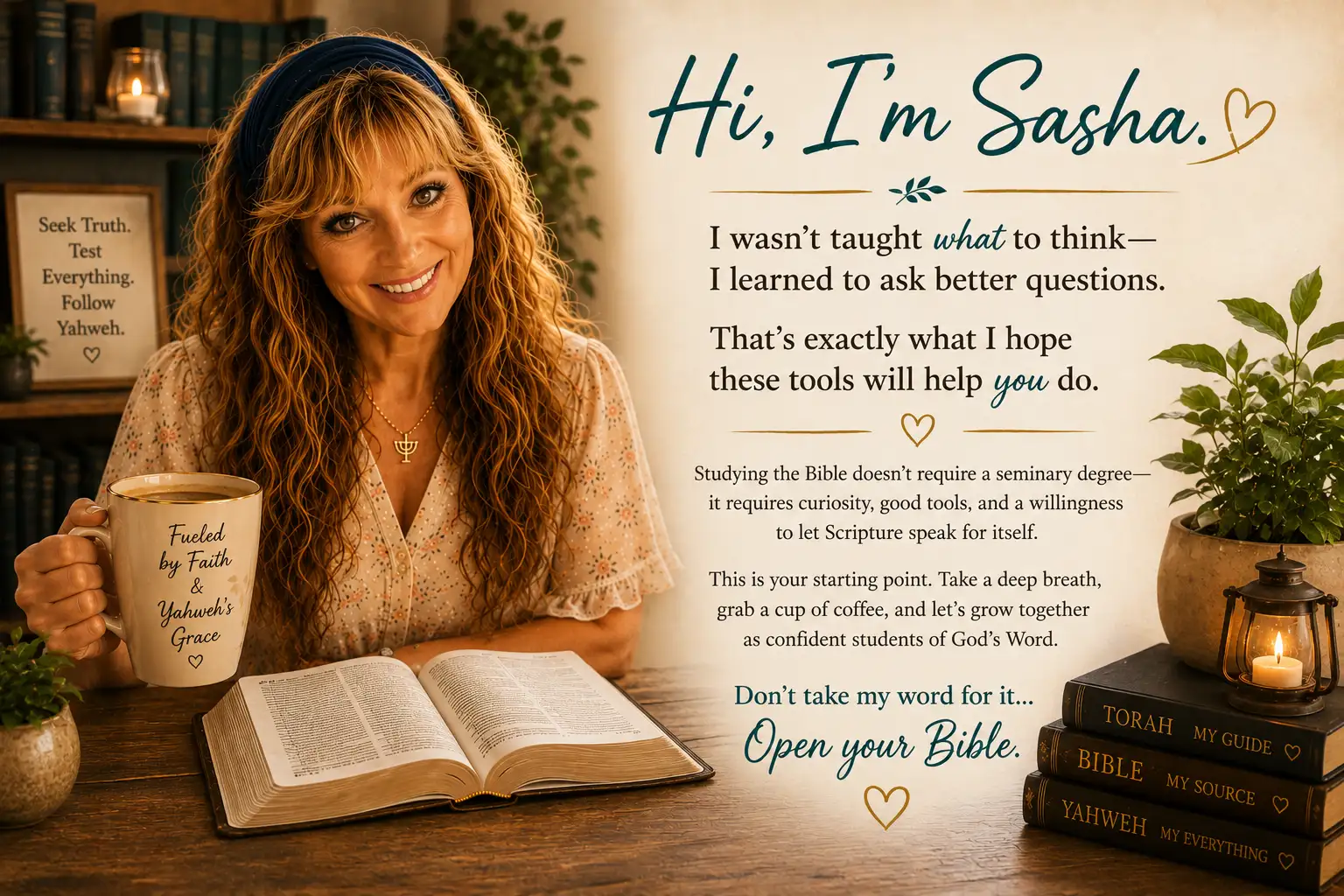
A Welcome From Sasha
If you have ever opened your Bible and thought, “Where do I even begin?” pull up a chair. Studying Scripture is not about possessing a seminary degree or already knowing every answer.
It is about asking good questions, using good tools, and letting Scripture provide context for Scripture. It is learning patiently, developing skill over time, and being willing to look again when the evidence challenges what you expected to find.
You do not have to learn everything today. Begin with one honest question, one useful skill, and one open Bible.
The Resource Library
Every tool on this page has one purpose: to help you study Scripture for yourself.
Begin with the resource that helps you read more carefully today. Each card opens a complete, established guide.
Learn how translation philosophy shapes English wording and how comparing translations can help you see where interpretation is happening.
Explore
Use original-language tools with care, follow words through context, and avoid turning a dictionary gloss into a secret meaning.
Explore
Follow quotations, echoes, repeated phrases, and themes so Scripture can introduce you to the rest of Scripture.
Explore
Read the paragraph, chapter, audience, genre, historical setting, and larger biblical story before deciding what a verse means.
Explore
Place biblical events among real people, places, kingdoms, journeys, and periods without letting background overpower the text.
Explore
Move from careful observation and sound interpretation toward faithful, concrete practice in everyday life.
ExploreWhen You Do Not Know Where to Begin
This simple sequence follows the established Open Your Bible study method: begin with the passage, gather the evidence, and let your interpretation come last.
Read the whole paragraph before opening a study tool.
Write down what you notice.
Who? What? When? Where? Why? What is repeated? What seems difficult?
Read nearby passages and useful cross-references.
Compare translations and identify important Hebrew or Greek words only where necessary.
Use historical background, maps, lexicons, concordances, and other study tools.
Compare interpretations instead of accepting the first explanation you find.
Ask what the evidence actually supports.
A Current Study Tool
AI can be useful at the study table, but it is still a tool—and it needs to be tested like every other source.
Use the tool.Test the answer.Open the Bible.
Put the Skills to Work
The Bible Study Toolbox teaches the skills. The guided Bible Studies give you somewhere to practice them.

One Open Bible at a Time
Good Bible students are not people who already know every answer. They are people willing to slow down, ask honest questions, check the context, learn how to use good tools, admit when the evidence is not as simple as they expected, and remain teachable before the Word.