
Torah — תּוֹרָה
A Guided Hebrew Word Study
From “law” to instruction, teaching, and the loving direction of Yehovah
Let’s walk through a complete word study together—using context, translation comparison, Strong’s numbers, lexicons, cross-references, and Scripture itself.
🔎 What Are We Looking For?
The Hebrew word Torah is commonly translated as law in English Bibles. That translation is not wrong—but for many modern readers, the English word law immediately brings to mind courtrooms, government regulations, punishments, and lists of rules.
Is that all the biblical word means?
Wait… what if our modern understanding of law is causing us to hear the passage differently than its original audience would have?
In this guided study, we are not going to search for a clever definition that supports something we already believe. We are going to slow down and examine the evidence.
Together, we will:
Read the passage in its literary context.
Compare several reliable translations.
Identify the original Hebrew word.
Examine its Strong’s number and lexicon entries.
Look at its related Hebrew root.
Trace how the word is used elsewhere in Scripture.
Return to the original passage and determine what meaning best fits.
You do not need to know Hebrew to follow along. I will show you where to look, what questions to ask, and which conclusions the evidence can—and cannot—support.
The goal is not to make the Bible say something new. The goal is to hear more clearly what it was already saying.
Open Psalm 1 →In Psalm 1:2, the English word law translates the Hebrew word Torah — תּוֹרָה.
This is our first important discovery—but it is not yet our final interpretation.
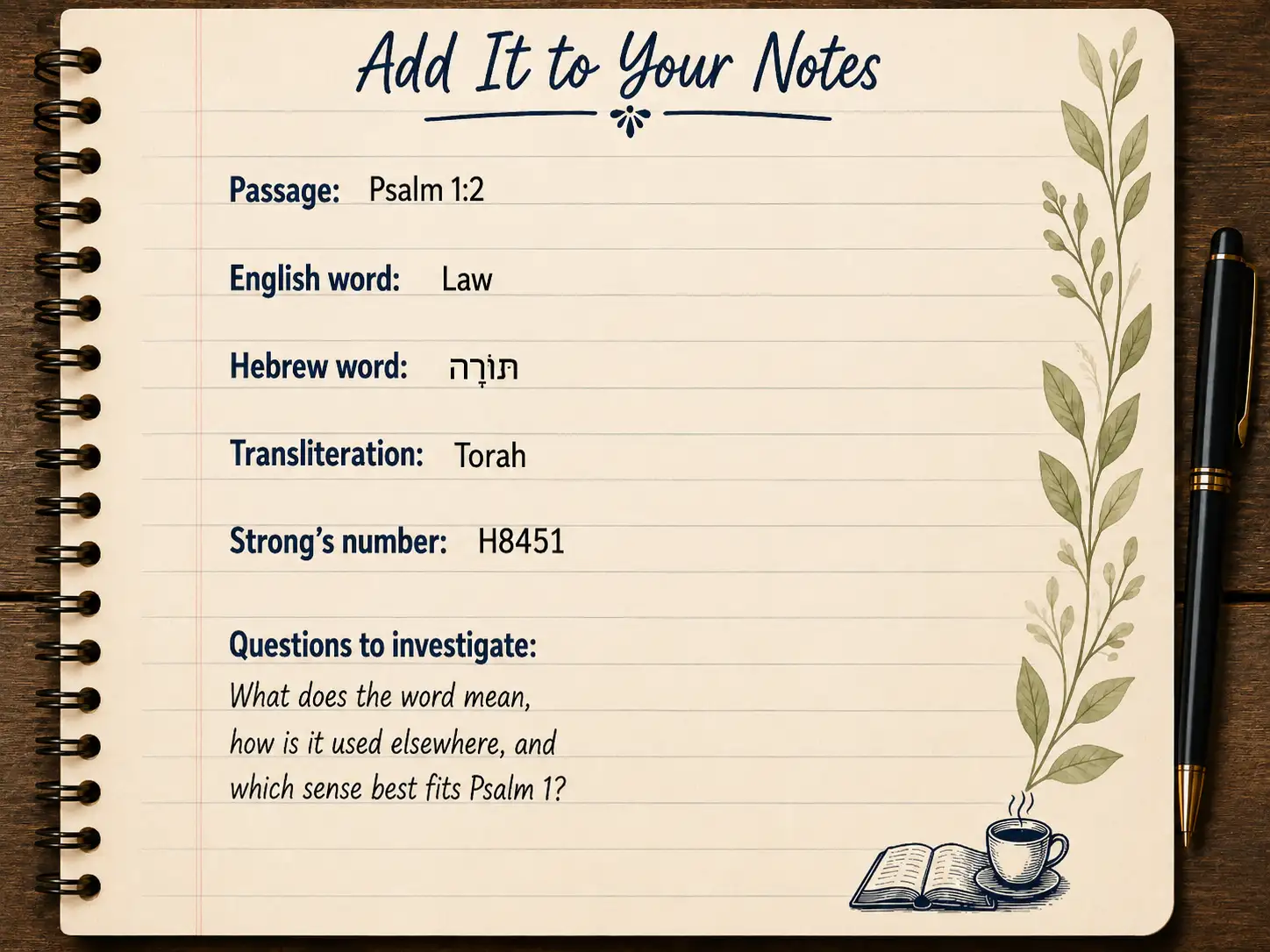
A Strong’s number helps us identify and locate the original word even when English translations render it differently. Think of H8451 as an identification number attached to the Hebrew word Torah. It allows us to find its lexicon entry and trace its appearances throughout Scripture.
Track with me: the Strong’s number does not tell us automatically what Torah means in every passage. It is an index—not a magic decoder ring.
At this stage, we are simply recording the evidence:
The English translation says law.
The original Hebrew word is Torah.
Its Strong’s number is H8451.
Lexicons may include words such as law, instruction, teaching, or direction in its range of meaning.
The surrounding context will help determine how that meaning should be understood in Psalm 1.
Do not choose your favorite definition yet.
First identify the word. Then examine its usage, its context, and the evidence provided by reliable lexicons.
Open Psalm 1:2 in Blue Letter Bible.
Select Tools beside the verse.
Open the Interlinear tab.
Find the English word law.
Click H8451 to view the entry for Torah — תּוֹרָה.
View Psalm 1:2 in Blue Letter Bible →We have identified the word. Now we are ready to examine what reliable lexicons say—and whether its related Hebrew root helps us understand the picture more clearly.
Examine the Root and Lexicon Entries
Now that we have identified Torah — תּוֹרָה — H8451, we need to find out how reliable Hebrew lexicons describe its range of meaning.
A lexicon is more detailed than a simple English dictionary. It may show possible meanings, grammatical information, examples of biblical usage, and the different ways a word functions throughout Scripture.
For Torah, Brown–Driver–Briggs gives the broad categories direction, instruction, and law. Its entries show that the word can refer to personal instruction, priestly teaching, prophetic instruction, individual commands, collections of laws, or the Torah given through Moses.
Track with me: that does not mean we can replace law with whichever word we happen to prefer. The lexicon gives us the word’s possible range. The passage tells us which part of that range is operating in Psalm 1.
What Do the Lexicons Show?
תּוֹרָה — Torah
Strong’s Number: H8451 Part of speech: Feminine noun
Possible English renderings:
Law
Instruction
Teaching
Direction
Ruling or individual instruction
The word can describe a specific instruction in one passage and the broader body of Yehovah’s covenant instruction in another. Context determines how narrowly or broadly it should be understood.
Examine the Related Root
Strong’s connects Torah with the Hebrew verb:
יָרָה — Yarah
Strong’s Number: H3384
Depending on its form and context, yarah can carry meanings such as:
To teach or instruct
To direct
To shoot or cast
This relationship helps us understand why Torah can communicate the idea of instruction or direction. However, we must be careful not to build an entire interpretation from a word picture alone. Yarah has a genuine range of usage, and an etymological connection does not mean every meaning of the root is present every time Torah appears.
Roots can provide background, but usage determines meaning.
🔎 Find It Yourself
Open the lexicon entry for H8451 — Torah.
Read the complete Strong’s entry.
Scroll down and examine the Brown–Driver–Briggs entry.
Record the major categories of meaning instead of selecting only the definition you like.
Open H3384 — Yarah.
Notice its different uses, including teaching, directing, shooting, and casting.
Return to Psalm 1 and ask which sense of Torah best fits the psalm.
☕ What Fits Psalm 1?
Psalm 1 describes someone who delights in Yehovah’s Torah, meditates on it day and night, and becomes like a fruitful tree planted beside streams of water.
That context presents Torah as more than a detached legal code. It is Yehovah’s authoritative instruction—His teaching and direction—that forms the righteous person’s thoughts, choices, and way of life.
This does not make the translation law incorrect.
It helps us hear more of what that law includes.
Torah is law, but it is not merely legislation. It is the authoritative instruction of Yehovah.
We have identified the word and examined its lexical range. Now we are ready to trace how Scripture itself uses Torah in other passages.
Step 5: Trace Torah Through Scripture
Now that we have examined the lexical range of Torah — תּוֹרָה, we need to see how Scripture actually uses the word.
This is where concordances and cross-references become so valuable. A lexicon tells us what a word can mean. Its appearances in Scripture help us see how biblical authors actually used it.
Track with me: we are not collecting verses that merely contain the same English word. We are tracing the same Hebrew word—H8451—even when translators render it as law, instruction, or teaching.
🔎 What Are We Looking For?
As you read each passage, ask:
Who is giving the Torah?
Who is receiving it?
Does it refer to a specific instruction or a broader body of teaching?
Is the emphasis on commands, wisdom, covenant, correction, or direction?
How does the surrounding passage describe its purpose or effect?
The goal is not to force every occurrence into one narrow definition. The goal is to recognize the themes that consistently surround the word.
📖 Compare These Key Passages
“This is the law that Moses set before the people of Israel.”
Here, Torah refers to the covenant instruction given to Israel through Moses. It includes commands, statutes, judgments, and teachings that shape Israel’s life with Yehovah.
What we notice: Torah can refer to an established body of covenant instruction.
“This Book of the Law shall not depart from your mouth, but you shall meditate on it day and night…”
Joshua is commanded to speak, meditate upon, and carefully obey the Book of Torah.
What we notice: Torah is meant to be studied continually and allowed to guide a person’s actions.
This language closely resembles Psalm 1.
“The law of Yehovah is perfect, reviving the soul…”
Torah is described as perfect, restorative, trustworthy, and wisdom-giving.
What we notice: Scripture does not portray Yehovah’s Torah merely as restrictive legislation. It is life-giving instruction that restores and teaches.
“Hear, my son, your father’s instruction, and forsake not your mother’s teaching.”
The Hebrew word translated teaching is Torah.
Wait… what?
A mother’s Torah is not a national legal code. In this context, it clearly means her instruction, teaching, and guidance.
What we notice: Torah can describe personal instruction given by a parent.
Malachi 2:6–7
“True instruction was in his mouth… For the lips of a priest should guard knowledge, and people should seek instruction from his mouth…”
The word translated instruction is Torah.
What we notice: Torah can refer to faithful teaching given by a priest who helps people understand Yehovah’s ways.
Isaiah 2:3
“For out of Zion shall go forth the law, and the word of Yehovah from Jerusalem.”
In this prophetic picture, the nations come to learn Yehovah’s ways so that they may walk in His paths.
What we notice: Torah is directly connected with Yehovah teaching people how to walk.
🧵 What Pattern Do We See?
Across these passages, Torah may refer to:
The covenant instruction given through Moses
A written body of commandments and teachings
Instruction from a parent
Teaching given by a priest
Wisdom that restores and directs
The instruction Yehovah will teach the nations
The contexts are different, but the common thread is authoritative instruction that teaches someone how to walk.
That does not remove the legal and commanding nature of Torah. It places those commands within a larger purpose: Yehovah is instructing His people in righteousness, wisdom, justice, holiness, and covenant faithfulness.
Torah is not less than law—but its biblical use is broader than the modern English idea of legislation alone.
⚠️ Do Not Flatten Every Passage
The same Hebrew word does not have to carry its entire range of meaning every time it appears.
In Proverbs 1:8, Torah refers to a mother’s teaching.
In Deuteronomy 4:44, it refers to the covenant instruction presented by Moses.
In Isaiah 2:3, it describes the instruction going forth from Zion as Yehovah teaches the nations His ways.
The word is the same. Its precise scope is determined by the context.
🔎 Find It Yourself
Open a concordance or interlinear Bible.
Search for H8451 rather than only the English word law.
Open several occurrences in their full chapters.
Record who gives the Torah and who receives it.
Notice what verbs appear beside it: hear, teach, meditate, obey, walk, delight, remember.
Group the passages by their different uses.
Ask what meaning is shared across the examples without erasing their contextual differences.
✍️ Add It to Your Notes
Covenant Torah: Deuteronomy 4:44 Written Torah: Joshua 1:8 Life-giving Torah: Psalm 19:7 Parental instruction: Proverbs 1:8 Priestly instruction: Malachi 2:6–7 Instruction for the nations: Isaiah 2:3
Repeated themes: Teaching, meditation, obedience, wisdom, direction, walking in Yehovah’s ways
Shared idea: Authoritative instruction that teaches people how to live and walk faithfully
We have now examined the word’s lexical range and traced its use across Scripture. It is time to return to Psalm 1 and ask what the psalmist meant in the passage where our study began.

Return to Psalm 1
Now we return to the passage where our study began.
We have read Psalm 1 in context, compared translations, identified the original Hebrew word, examined its lexical range, considered its related root, and traced its use across Scripture.
The purpose of all that research was not to wander farther away from the passage. It was to come back and hear it more clearly.
📖 Read Psalm 1:1–3 Again
Psalm 1 presents two contrasting paths:
The way of the righteous
The way of the wicked
The righteous person refuses the counsel, path, and influence of wickedness. Instead, that person delights in the Torah of Yehovah and meditates on it day and night.
The result is pictured as a tree planted beside streams of water—rooted, nourished, fruitful, and able to endure.
🔎 What Have We Learned?
When we first read the English word law, we might have imagined only a list of rules or legal requirements.
Our study showed that Torah — תּוֹרָה can communicate:
Law
Instruction
Teaching
Direction
Authoritative guidance
In Psalm 1, Torah is something the righteous person:
Delights in
Meditates upon continually
Allows to shape an entire way of life
That context helps us understand that the psalmist is not describing reluctant compliance with an unpleasant rulebook.
He is describing someone who treasures Yehovah’s authoritative instruction and allows it to form the roots, direction, and fruit of his life.
Before the Word Study
“His delight is in the law of Yehovah.”
A modern reader may hear:
“He dutifully follows religious rules.”
After the Word Study
A fuller explanatory sense would be:
“His delight is in the Torah of Yehovah—His authoritative law, teaching, and instruction—and he continually meditates upon it.”
This is not meant to replace the biblical text with our own private translation. It is an explanatory paraphrase that helps us hear the fuller range carried by the Hebrew word.
🌳 Why the Tree Matters
The tree in Psalm 1 is not healthy because it occasionally visits the water.
It is planted there.
In the same way, the righteous person does not merely consult Yehovah’s instruction when convenient. Torah continually shapes how that person thinks, chooses, walks, and responds.
Meditation is more than reading a verse quickly and moving on. It carries the idea of repeatedly considering, speaking, pondering, and allowing the words of Yehovah to settle deeply into the heart and mind.
The fruit does not appear because the tree is straining to look impressive.
The fruit grows because the tree remains connected to its source of nourishment.
Are you picking up what I’m throwing down?
Torah is not presented here as the enemy of a flourishing life. It is part of the water nourishing it.
⚠️ Keep the Whole Passage Together
Our word study should not cause us to ignore the rest of Psalm 1.
The psalm is not merely defining Torah. It is contrasting two ways of living. The person who delights in Yehovah’s instruction also rejects corrupt counsel, sinful paths, and mockery.
Studying the Hebrew word deepens the passage, but the complete message still comes from the whole psalm.
Context gets the final word.
☕ The Takeaway
We did not discover a secret meaning hidden from ordinary readers. We slowed down, examined the evidence, and recovered dimensions of meaning that the single English word law may not immediately communicate to a modern audience.
Torah is not less than law.
But in Psalm 1, it is clearly more than the cold, restrictive idea many people associate with that English word.
It is the treasured instruction of Yehovah—the source beside which a faithful life becomes rooted, nourished, and fruitful.
Don’t take my word for it… Open your Bible.
Now that we have completed the word study, we need to be honest about what the evidence establishes—and what conclusions it does not establish by itself.
What This Word Study Does—and Does Not—Prove
A careful word study can sharpen our understanding, but it must not be asked to carry more weight than the evidence can support.
We have learned something important about Torah — תּוֹרָה. We have not, however, answered every theological question involving Torah, covenant, obedience, or the believer’s life from one Hebrew word in one psalm.
Track with me: good Bible study does not exaggerate the evidence. It follows the evidence as far as it goes—and then stops.
✅ What This Study Does Show
“Law” is accurate, but may sound narrower in modern English
The Hebrew word Torah genuinely includes law and commandments. However, its biblical range also includes instruction, teaching, direction, and authoritative guidance.
That fuller range helps modern readers avoid hearing Torah as nothing more than impersonal legislation.
Context determines how Torah functions in a passage
Torah can refer to parental instruction, priestly teaching, a particular ruling, the written Torah of Moses, or Yehovah’s covenant instruction more broadly.
The word remains the same, but its precise scope must be determined from the surrounding passage.
Psalm 1 presents Torah positively
In Psalm 1, Torah is something the righteous person:
Delights in
Meditates upon continually
Allows to shape an entire way of life
It is associated with rootedness, nourishment, fruitfulness, stability, and faithfulness—not spiritual bondage or lifeless rule-keeping.
Scripture connects Torah with learning how to walk
Across the passages we examined, Torah repeatedly appears alongside ideas such as hearing, teaching, meditating, obeying, learning, and walking in Yehovah’s ways.
The shared picture is one of authoritative instruction that forms a faithful life.
Original-language tools can deepen our reading
Comparing translations, identifying the Hebrew word, consulting lexicons, and tracing its biblical usage helped us notice meaning that the English word law may not immediately communicate to a modern reader.
The tools did not replace Scripture.
They sent us back to Scripture with better questions.
❌ What This Study Does Not Show
It does not prove that “law” is a mistranslation
The English word law is a legitimate translation of Torah in many passages.
Our study does not expose a translation conspiracy or prove that English Bibles are hiding the truth. It shows that a single English word may not always carry every dimension of the Hebrew concept.
It does not mean “instruction” should replace “law” everywhere
Because Torah can include instruction does not mean we may automatically substitute instruction in every verse.
In some passages, the legal or commanding sense is prominent. In others, teaching or direction is emphasized. Once again, context gets the final word.
It does not mean every possible definition belongs in Psalm 1
A lexicon lists a word’s possible uses. It does not tell us to pour the entire dictionary entry into every occurrence.
Torah does not mean everything it has ever meant every time it appears.
It does not allow the root to override actual usage
The relationship between Torah and yarah can provide helpful background, but a word’s history or related root does not automatically determine its meaning in a particular sentence.
The root may illuminate the word.
It does not control the passage.
It does not settle every debate about Torah observance
Psalm 1 clearly speaks positively about Yehovah’s Torah. But this word study alone does not answer every question about covenants, Israel, Gentile believers, the priesthood, sacrifices, circumcision, dietary instructions, or how particular commands should be applied today.
Those questions require careful study of the whole counsel of Scripture—not one lexicon entry wearing a superhero cape. 😂
It does not make us Hebrew scholars
Using Strong’s numbers and reading an English lexicon entry is valuable, but it is not the same as fluency in biblical Hebrew.
These tools help ordinary readers study more carefully. They should also make us more humble about the limits of our knowledge.
⚖️ The Responsible Conclusion
Based on the lexical evidence, the broader scriptural usage, and the context of Psalm 1, we can responsibly conclude:
In Psalm 1, Torah refers to the authoritative law, teaching, instruction, and direction of Yehovah—the revelation in which the righteous person delights, meditates, and allows to shape the course of life.
We should not conclude:
“Torah never means law,” “Every command is merely optional advice,” or “This one word study settles every theological disagreement about Torah.”
That would be moving beyond the evidence.
☕ A Berean Reminder
The goal of original-language study is not to make our preferred doctrine sound more impressive.
It is to test our assumptions, understand the author more accurately, and submit our conclusions to the full testimony of Scripture.
A responsible word study clarifies the text. An irresponsible one uses definitions to escape it.
Don’t take my word for it… Open your Bible.
Now that we have seen both the value and the limits of a word study, let’s look at the most common mistakes people make when using Hebrew and Greek tools.
Common Word-Study Mistakes
Original-language tools can deepen our understanding of Scripture—but they can also make a bad interpretation sound extremely impressive.
Wait… what?
A person can quote Hebrew letters, mention Strong’s numbers, list several definitions, and still completely miss what the biblical author meant. More information is useful only when it is handled carefully.
Here are the mistakes we want to avoid.
1. Choosing the Definition We Like Best
A lexicon may list several possible meanings for one word. That does not mean we may select whichever definition best supports the conclusion we already wanted.
The passage determines which meaning fits.
For example, Torah can refer to instruction, teaching, law, a particular ruling, or a broader body of covenant instruction. We cannot simply announce that it means instruction in every passage because that sounds warmer than law.
A lexicon gives us possibilities. Context gives us the meaning.
2. Pouring Every Definition Into One Verse
A word does not carry every meaning it has ever had each time it appears.
Think about the English word bank. It can refer to a financial institution, the side of a river, or tilting an airplane. Nobody reads “she sat on the riverbank” and imagines a teller window, checking account, and landing maneuver all hiding inside the sentence.
The same principle applies to Hebrew and Greek.
This mistake is sometimes called importing the word’s entire semantic range into one occurrence. Plainly put, it means stuffing the whole dictionary entry into one verse.
Do not do that.
3. Treating Strong’s Numbers Like Inspired Definitions
Strong’s numbers are extremely useful identification tools. They help us locate the same Hebrew or Greek word throughout Scripture.
But H8451 does not interpret Psalm 1 for us.
A Strong’s number is an index. It is not the original word itself, a theological conclusion, or a secret code hidden beneath the English Bible.
Use it to find the word.
Then read the passage, examine the lexicon entry, trace the usage, and compare the evidence.
4. Building Meaning From the Root Alone
The relationship between Torah and yarah may help us understand why Torah can carry ideas of teaching or direction.
But related roots do not give us permission to invent word pictures or force every meaning of the root into the derived word.
English provides an easy example. The words butterfly and butter are historically connected in form, but studying dairy products will not explain what a butterfly means in a sentence.
Roots may provide background.
Actual usage carries greater weight.
5. Assuming the Oldest Meaning Must Be the Real Meaning
Words change over time. A word’s earlier history does not automatically determine how a later author used it.
The question is not merely:
“Where did this word come from?”
The more important question is:
“How was this author using this word in this passage?”
Etymology can be interesting. It is not a time machine that allows us to ignore context.
6. Assuming One English Word Equals One Hebrew or Greek Word
English translations may use the same word to translate several different original-language words. They may also use several English words to translate one Hebrew or Greek word.
That is why searching only the English word law will not necessarily show every occurrence of Torah—and may also bring up verses where law translates a different original word.
This is where Strong’s numbers and interlinear tools help us trace the actual Hebrew or Greek word rather than merely following an English gloss.
7. Treating the Interlinear Like a Perfectly Literal Translation
An interlinear can help us see which original word sits behind the English text. But the short English gloss underneath a Hebrew or Greek word is not always a complete definition.
Languages do not line up word-for-word like matching puzzle pieces.
Word order, grammar, idioms, context, and sentence structure all matter. A very literal gloss may actually sound misleading when separated from the complete sentence.
Use the interlinear to investigate—not to rewrite the Bible one word at a time.
8. Ignoring Grammar
Two forms of the same word may function differently within a sentence.
Number, gender, case, verb form, tense, voice, mood, Hebrew stem, and sentence structure can all affect meaning. You do not need to master every grammatical label before beginning a word study, but you should not pretend the labels are irrelevant either.
Sometimes the most important discovery is not a dramatic new definition.
It is noticing who is doing the action, who receives it, whether it is a command, or how the phrase connects with the sentence around it.
9. Tracing Every Occurrence Without Reading the Passages
A concordance may give you dozens or hundreds of results. Scanning the verse fragments is not the same as studying the word’s usage.
Open the passages.
Read the surrounding paragraphs.
Notice the author, audience, subject, and purpose.
Five carefully studied occurrences are often more useful than fifty verses skimmed in isolation.
10. Allowing a Word Study to Override the Whole Passage
Sometimes people become so fascinated by one word that they forget the author wrote an entire sentence, paragraph, chapter, and book.
Psalm 1 is not merely a definition of Torah.
It contrasts two paths, two influences, and two outcomes. The Hebrew word enriches that message, but it does not replace it.
Word studies serve the passage. The passage does not serve the word study.
11. Using Original Languages to Sound Unchallengeable
Saying, “Well, in the Greek…” can make an argument sound authoritative even when the person has only read a brief online definition.
Hebrew and Greek tools should make us more careful and humble—not more dramatic and impossible to question.
You may discover something valuable.
You may also misunderstand the grammar, choose the wrong definition, or overlook evidence that does not support your conclusion.
Scholars compare sources for a reason.
12. Starting With the Conclusion
This may be the most common mistake of all.
A responsible word study asks:
“What does the evidence show?”
An irresponsible one asks:
“How can I make the Hebrew or Greek prove what I already believe?”
Track with me: the goal is not to win an argument with fancier vocabulary.
The goal is to hear Scripture accurately—even when it challenges us.
A Safer Word-Study Checklist
Before accepting your conclusion, ask:
Did I read the entire passage?
Did I compare translations?
Did I identify the correct original word?
Did I read the full lexicon entry?
Did I consider grammar?
Did I examine several biblical uses?
Did I allow context to narrow the meaning?
Did I avoid forcing the root into the passage?
Does my conclusion fit the author’s larger message?
Am I claiming more than the evidence proves?
☕ Sasha’s Rule of Thumb
If your word study creates a meaning that nobody could reasonably understand from the sentence, passage, or wider context, slow down. You may have discovered something fascinating—or you may have just built a theological treehouse out of one dictionary definition. 😂
Original-language study is not about finding secret knowledge.
It is about becoming a more patient, responsible, and attentive reader of Scripture.
Don’t take my word for it… Open your Bible.
Now it is your turn to practice the same process with another passage—without skipping the context, chasing the most exciting definition, or wearing the Strong’s number like a theological superhero cape.
Your Turn: Guided Practice
Now it is your turn to follow the same process with another word from Psalm 1.
Don’t worry—I’m not tossing you into the deep end with a Hebrew lexicon and waving goodbye. 😂 This exercise walks you through each step, but you will do the investigating before checking the suggested conclusion.
🔎 Your Word to Study
“Meditates” — Psalm 1:2
“But his delight is in the Torah of Yehovah, and on His Torah he meditates day and night.”
We have already studied Torah. Now investigate the word translated meditates.
Before opening any study tool, read Psalm 1 again and ask:
What does meditation appear to involve in this psalm, and what role does it play in the righteous person’s life?
Step 1: Read the Passage in Context
Read all six verses of Psalm 1.
Record what you notice:
What two ways of life are contrasted?
What influences does the righteous person reject?
What does the righteous person delight in?
What image describes the result of this way of life?
How often does the person meditate?
Do not define the word yet. First understand what the psalm is communicating as a whole.
Step 2: Compare Bible Translations
Compare Psalm 1:2 in at least four translations.
Look for differences in the way they translate or explain meditates.
Create a small comparison chart:
Translation
Wording used
Translation 1
Translation 2
Translation 3
Translation 4
Then ask:
Do all the translations use meditate?
Do any use think about, ponder, recite, or similar language?
Do any include a footnote?
What questions do the differences raise?
Translation comparison helps us notice where an English word may not communicate the complete picture.
Step 3: Identify the Original Hebrew Word
Open Psalm 1:2 in an interlinear Bible and locate the word translated meditates.
Record:
English word: ______________________
Hebrew word: ______________________
Transliteration: ______________________
Strong’s number: ______________________
Part of speech: ______________________
Do not choose a definition yet. At this stage, you are simply identifying the original word.
Step 4: Examine the Lexicon Entry
Read the entire lexicon entry—not merely the first English gloss.
Record the major meanings or uses you find:
Then ask:
Does the word always refer to quiet, internal thought?
Can it involve speaking, murmuring, uttering, devising, or pondering?
Which meanings appear positive?
Which meanings depend heavily on context?
A word’s range may be wider than its meaning in one particular verse.
Step 5: Trace the Word Through Scripture
Search for the Strong’s number and examine several passages where the same Hebrew word appears.
Suggested passages include:
For each passage, record:
Passage
English rendering
What is being described?
Notice that the same Hebrew word may be translated differently depending on what the person is considering, speaking, or devising.
Ask:
What common idea connects these different uses without forcing them all to mean exactly the same thing?
Step 6: Return to Psalm 1
Now reread Psalm 1:2.
Based on the sentence, the entire psalm, the lexicon entry, and the word’s use elsewhere, answer:
Which meaning best fits Psalm 1:2?
What evidence supports that conclusion?
How does this deepen your understanding of meditating on Torah day and night?
✍️ Write Your Conclusion
Complete this statement:
In Psalm 1:2, the Hebrew word translated meditates communicates the idea of ____________________________________________. The righteous person does not merely read Torah occasionally. Instead, ____________________________________________.
✅ Check Your Work
Suggested Findings
Hebrew word: הָגָה
Transliteration: hagah
Strong’s number: H1897
Possible uses: To meditate, muse, ponder, utter, murmur, speak, devise, or plot—depending on the context.
The range of hagah shows why context matters. In Psalm 2:1, the word can describe the nations devising or plotting. In passages such as Joshua 1:8 and Psalm 1:2, it describes sustained engagement with Yehovah’s instruction.
In Psalm 1, the righteous person’s meditation is not presented as emptying the mind. It is an ongoing filling of the thoughts—and possibly the quiet speech—with Torah. The person repeatedly considers Yehovah’s instruction until it shapes the way he walks.
Suggested Conclusion
In Psalm 1:2, hagah describes sustained reflection upon Yehovah’s Torah—pondering it, rehearsing it, and allowing it to occupy the mind continually. The righteous person does not merely encounter Torah occasionally; Yehovah’s instruction becomes the continual subject of thought and meditation.
☕ The Lesson Behind the Lesson
Did you notice what happened?
We did not grab the most dramatic definition and paste it into Psalm 1. We read the passage, compared translations, identified the Hebrew word, examined its range, traced its usage, and then returned to the context.
That is responsible word study.
The tools helped us investigate the text. They did not give us permission to escape it.
Don’t take my word for it… Open your Bible.
☕ Coffee with Sasha

Can I tell you what I love most about this study?
We did not uncover a secret code available only to scholars. We simply slowed down. We asked better questions. We used the tools carefully, followed the evidence, and then returned to the passage where we began.
And Psalm 1 became richer—not because we forced a new meaning into it, but because we stopped rushing past what was already there.
For many of us, the word law carries years of baggage. We may hear restriction, punishment, legalism, or cold religious obligation. But the psalmist saw Yehovah’s Torah as something delightful—something worth pondering day and night. He pictured the person rooted in that instruction as a living, fruitful tree beside streams of water.
Wait… what?
What many people have been taught to view as a burden is pictured here as nourishment.
That does not mean every question about Torah has now been answered. It does mean we should be careful about allowing modern assumptions, religious traditions, or uncomfortable feelings to define a biblical word before Scripture does.
Track with me: the goal of word study is not to make us feel smarter than everyone else. It is to make us slower to speak, quicker to examine the evidence, and more willing to let Scripture correct what we thought we already knew.
So the next time someone says, “The original Hebrew really means…” don’t be intimidated—and don’t accept it automatically. Open the passage. Check the word. Read the entire lexicon entry. Trace its usage. Examine the context. Then ask whether the conclusion honestly follows from the evidence.
You are capable of doing this.
You do not need a seminary degree, an enormous library, or perfect Hebrew pronunciation. You need reliable tools, patience, humility, and a willingness to keep returning to the text.
The deeper we study, the less interested we should become in sounding impressive—and the more interested we should become in hearing Yehovah accurately.
That is what being a Berean looks like.
Don’t take my word for it… Open your Bible.
Continue Studying
A single word study can open the door to a much larger understanding of Scripture—but it should never become an isolated conclusion.
Keep following the connections. Examine the context. Compare related passages. Learn how geography, history, language, and the whole counsel of Scripture work together.

📖 Continue With the Word Studies Library
The live Word Studies library now includes dedicated studies of Torah, Shema, Charis, Pistis, and Hamartia. Each follows the same careful process: read the passage, compare translations, identify the original word, examine reliable resources, trace its biblical usage, and return to the context.
🌱 Build Your Next Skill
You have completed a full guided Hebrew word study. Now strengthen another part of your Bible-study process by choosing one practical next step.