BIBLE STUDIES • PEOPLE OF THE BIBLE
Abraham — What Does the Bible Mean When It Calls Abraham Faithful?
Genesis 12–25, Promise, Fear, Obedience, Failure—and the Faith Scripture Keeps Returning To
A Guided People of the Bible Study
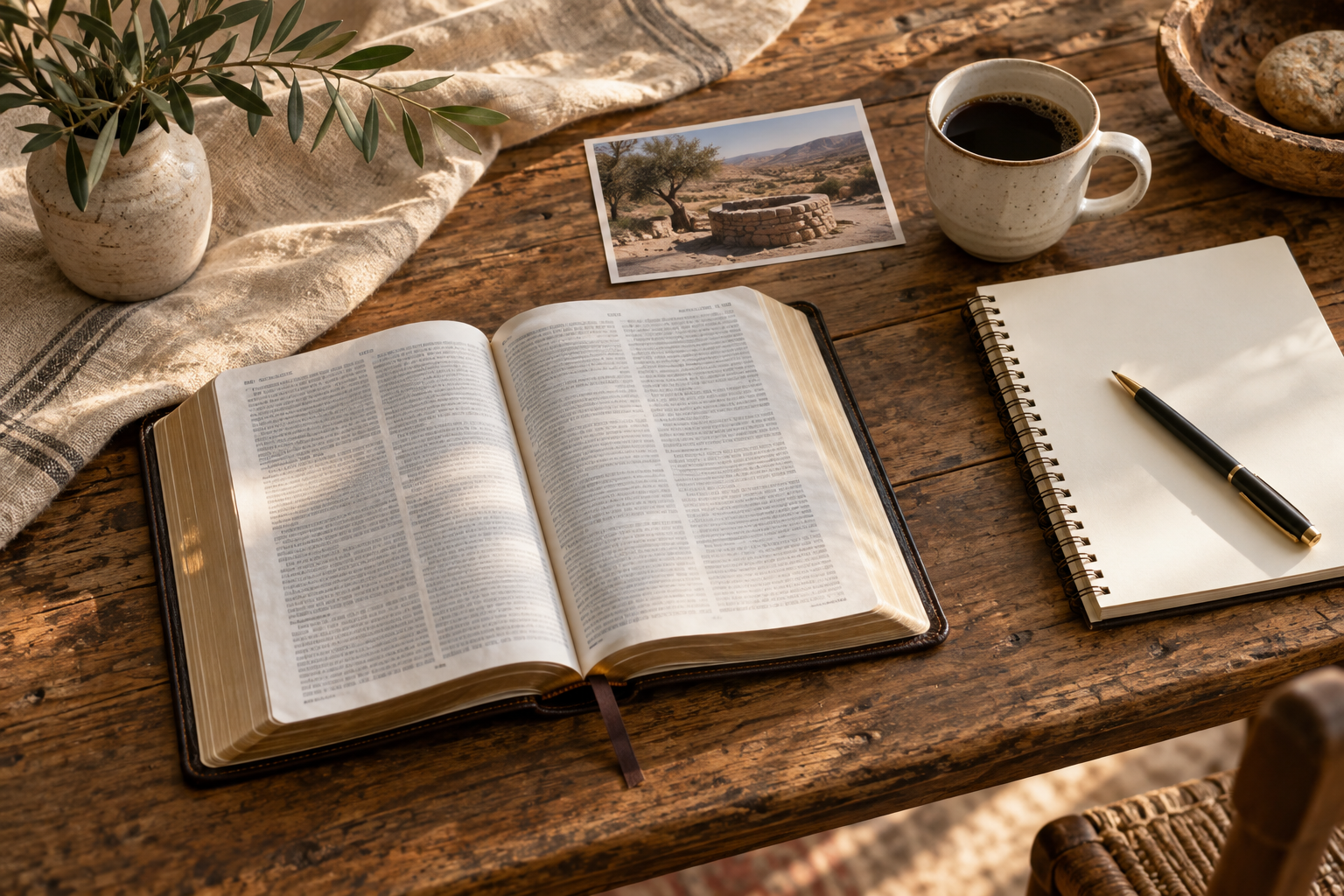
In One Minute
Scripture calls Abraham faithful while openly narrating his fear, questions, and repeated failures. Follow Genesis 12–25 before comparing the later biblical arguments: Abraham trusts Yehovah’s promise, and that trust becomes visible in obedience. Paul rejects earning and boasting; James rejects a profession of faith that never acts. Keep Abraham’s trust, obedience, and failures together as you read.
Primary passages: Genesis 11:27–25:11. Compare: Genesis 26:1–5; Nehemiah 9:7–8; Isaiah 41:8; 2 Chronicles 20:7; Romans 4; Galatians 3:6–9; Hebrews 11:8–19; James 2:14–26.
Before We Begin
Pour the coffee. Abraham is one of those biblical people we think we already know before we actually sit down with his whole story. Father Abraham. Man of faith. Friend of God. Patriarch. We can collect those titles so quickly that the man underneath them starts to disappear.
Genesis will not let us keep a polished Sunday-school version of him. Abram leaves when Yehovah calls, builds altars, trusts impossible promises, rescues Lot, intercedes for Sodom, accepts circumcision, and walks Isaac up a mountain because God has spoken. The same man also panics in famine, puts Sarai in danger by calling her his sister, repeats that pattern years later, participates in the Hagar plan, laughs at the promise of a son, and sometimes asks God very blunt questions.
That does not make Abraham a fraud. It makes the biblical claim about his faithfulness more interesting. Scripture remembers him as a model of faith without pretending that every decision he made was faithful. The question is not whether Abraham ever failed. Genesis answers that before we finish our first cup of coffee. The question is what kind of life the Bible is describing when it holds Abraham up as faithful.
So we are going to follow the story before importing a theological slogan. We will notice the promises, Abraham’s responses, his failures, the things he actually obeys, and the way later Scripture reads him. Then we can ask what words like faith, belief, obedience, righteousness, and works are doing in their own contexts instead of forcing them into a fight the biblical writers may not be having.
PEOPLE-STUDY RULE
Do not flatten a biblical person into a virtue word. Follow the whole story. Ask what Yehovah says, what the person does, where the person fails, how the person responds, and how later Scripture remembers the life.
Before reading further, what does “Abraham was a man of faith” mean to you right now?
____________________________________________________________
____________________________________________________________
Which moment in Abraham’s life most strongly shapes your picture of him?
____________________________________________________________
____________________________________________________________
Meet Abram Before He Becomes “Father Abraham”
Read Genesis 11:27–32 before Genesis 12. Abram does not first appear floating alone in a spiritual spotlight. He belongs to a family moving from Ur toward Canaan, settling in Haran along the way. Sarai is introduced with a painful fact that will drive much of the next ten chapters: she has no child.
Then Genesis 12 opens with Yehovah speaking directly to Abram. The call is costly and deliberately unfinished. Leave your land, your kindred, and your father’s house; go to the land I will show you. Abram is not handed a map, a timeline, a child, or a detailed explanation of how the promise will work. He is handed a word.
The promises are enormous: a great nation, a great name, blessing, protection, and blessing flowing outward to the families of the earth. The text then gives us the first important answer to our question. Abram goes. Faith in Genesis is not presented as a private opinion tucked inside his head. The trust becomes visible because he packs.
Read Genesis 12:1–9. What does Yehovah promise Abram?
____________________________________________________________
____________________________________________________________
____________________________________________________________
What does Abram actually do in response?
____________________________________________________________
____________________________________________________________
Which parts of the promise are still completely unresolved when Abram enters Canaan?
____________________________________________________________
____________________________________________________________
Faith Starts Moving—and Then Famine Arrives
If Genesis wanted to give us a tidy hero story, chapter 12 was the perfect place to stop. Abram obeyed. Altars were built. Everybody could go home encouraged. Instead, the land of promise experiences famine almost immediately, and Abram goes down to Egypt.
There he becomes afraid that Sarai’s beauty will cost him his life. He asks her to identify herself as his sister so that it may go well with him. The statement has a family connection behind it, as Genesis 20 later explains, but the strategy is still designed to conceal the marriage and protect Abram. Sarai is taken into Pharaoh’s household, and Abram receives wealth while she is there.
Yehovah intervenes. Pharaoh, not Abram, voices the moral outrage in the scene and sends them away. That detail should slow us down. The man who trusted enough to leave home can still respond to immediate danger with fear and self-protection. Biblical faith is not the same thing as never being afraid, and a faithful person can still make decisions that put someone else at risk.
Read Genesis 12:10–20. What seems to drive Abram’s plan in Egypt?
____________________________________________________________
____________________________________________________________
Who protects Sarai in the story?
____________________________________________________________
____________________________________________________________
What does this episode keep you from claiming about biblical “faithfulness”?
____________________________________________________________
____________________________________________________________
Altars, Lot, and a King Named Melchizedek
Genesis 13–14 lets us watch Abraham’s character in different kinds of pressure. When Abram and Lot’s households become too large to remain together peacefully, Abram gives Lot the first choice of land even though Abram is the one carrying the promise. Lot chooses the lush Jordan plain; Abram remains in Canaan, where Yehovah repeats the land promise.
Then Lot is captured in a regional war. Abram does not shrug and say, “He chose Sodom.” He mobilizes his household, pursues the coalition, rescues Lot and the captives, and returns with the goods. On the way home, two kings meet him: Melchizedek blesses him in the name of God Most High, and the king of Sodom offers him the recovered property.
Abram gives a tenth to Melchizedek and refuses to enrich himself from Sodom’s king. The text does not pause to explain a later tithing system here; it shows Abram publicly locating his victory and blessing under God Most High rather than allowing Sodom to claim the source of his prosperity. Faith is beginning to look like allegiance as well as trust.
What choices in Genesis 13–14 show Abram trusting the promise without grasping for advantage?
____________________________________________________________
____________________________________________________________
____________________________________________________________
What does Abram refuse from the king of Sodom, and what reason does he give?
____________________________________________________________
____________________________________________________________
“What Will You Give Me?” Is Still Faith Talking
Genesis 15 begins with Yehovah telling Abram not to fear. Abram’s answer is not a polished testimony. He asks what God can give him when he is still childless. The promised future seems to be heading toward a household servant instead of a son.
Notice what the text permits: a person can trust Yehovah and still ask how the promise is going to work. Abram’s questions are not edited out to protect his reputation. Yehovah answers by taking him outside and redirecting his imagination toward the stars. The promise becomes specific: an heir from Abram’s own body and descendants beyond counting.
Then comes one of the most influential sentences in the entire Bible: Abram trusts Yehovah, and that trust is reckoned in connection with righteousness. The Hebrew verb behind “believed” comes from the same word family that carries ideas of firmness, reliability, and trustworthiness. Abram is staking himself on the reliability of the One who spoke.
GENESIS 15:6 — SLOW DOWN HERE
The Hebrew second clause is famously compact: “he reckoned it to him as righteousness.” The grammatical subject of “reckoned” is not explicitly named. The traditional reading—followed by the ancient Greek translation and by Paul and James—is that God reckons Abram’s trust as righteousness. A minority reading takes Abram as the one recognizing Yehovah’s righteousness. The grammar deserves honesty, but the later biblical writers clearly receive the verse in the first sense when they quote it.
Either way, do not detach verse 6 from the conversation. Abram has not performed a spectacular religious achievement. He has heard a promise he cannot manufacture and trusted the God who made it. The covenant ceremony that follows dramatizes God’s commitment to the promise even while Abram’s descendants’ future includes affliction, delay, and deliverance.
Read Genesis 15:1–6. What question does Abram ask before verse 6?
____________________________________________________________
____________________________________________________________
What exactly has Yehovah promised immediately before Abram believes?
____________________________________________________________
____________________________________________________________
What would be lost if Genesis 15:6 were reduced to an abstract slogan about “faith versus works”?
____________________________________________________________
____________________________________________________________
____________________________________________________________
Then Genesis 16 Happens
One chapter after the famous statement about faith, Abram and Sarai try to solve the child problem through Hagar. That sequence matters. Genesis does not place “faith” in chapter 15 and then imply that Abraham never again struggles to trust the timing or shape of the promise.
Sarai proposes the plan, Abram listens, Hagar conceives, and the household fractures. Whatever ancient custom helps us understand the arrangement, the story shows real human damage. Abram’s response to the conflict returns Hagar to Sarai’s power, and Hagar flees into the wilderness.
The point here is not to retry the Hagar study. It is to let Abraham remain inside his own full story. Scripture can say that Abram trusted Yehovah in Genesis 15 and still narrate Genesis 16 without embarrassment. Faithfulness is not biblical code for “every choice this person made was right.”
What happens between Genesis 15:6 and the birth of Ishmael in Genesis 16?
____________________________________________________________
____________________________________________________________
____________________________________________________________
How does Genesis 16 complicate an overly simple definition of faith?
____________________________________________________________
____________________________________________________________
A New Name, a Covenant Sign, and a Laugh
Genesis 17 arrives when Abram is ninety-nine. Yehovah identifies Himself as El Shaddai, commands Abram to walk before Him and be blameless, expands the covenant promises, and changes Abram’s name to Abraham. The man promised a household becomes “father of a multitude.” Sarai becomes Sarah, and the covenant line is specified through a son she herself will bear.
Abraham falls on his face and laughs. He asks whether a hundred-year-old man and ninety-year-old woman can have a child, then points to Ishmael: if only Ishmael might live before You. We do not have to choose between “Abraham had faith” and “Abraham struggled with the absurdity of the promise.” Genesis gives us both.
Yehovah blesses Ishmael and firmly identifies Isaac as the covenant son. Abraham then circumcises himself, Ishmael, and every male in his household that very day. Whatever we make of the laughter, the chapter closes with concrete obedience. Abraham’s faith keeps taking bodily form.
Read Genesis 17:1–27. What commands does Abraham receive, and what does he do?
____________________________________________________________
____________________________________________________________
____________________________________________________________
What does Abraham’s laughter reveal? What does the text explicitly say—and what must remain interpretation?
____________________________________________________________
____________________________________________________________
Abraham Argues With God
Then we reach one of my favorite Abraham scenes because it refuses the idea that faith means passive agreement. In Genesis 18, Yehovah speaks about Abraham’s future role: he is to command his children and household to keep the way of Yehovah by doing righteousness and justice. Those two words matter. The chosen family is not chosen merely to possess promises; it is meant to embody a way.
When Abraham learns that Sodom is under judgment, he does not say, “Whatever You say.” He steps closer and asks whether the Judge of all the earth will sweep away the righteous with the wicked. The conversation moves from fifty righteous people down to ten.
This is not unbelief masquerading as courage. Abraham’s appeal is grounded in what he believes about Yehovah’s justice. Biblical trust can be bold enough to ask God questions precisely because it trusts His character.
Read Genesis 18:16–33. What does Yehovah say Abraham’s household is supposed to learn?
____________________________________________________________
____________________________________________________________
On what aspect of Yehovah’s character does Abraham base his intercession?
____________________________________________________________
____________________________________________________________
And Then He Does It Again
Genesis 20 is uncomfortable because the Egypt story was not a one-time beginner mistake. Abraham again identifies Sarah as his sister, this time in Gerar. Abimelech takes her, and God intervenes before the marriage is consummated.
Abraham explains that he feared there was no fear of God in the place and that he would be killed because of Sarah. He also explains the kinship truth behind the sister language. But partial truth does not erase the purpose of the strategy. Fear again shapes his decision.
This matters for our definition of faithfulness. Abraham can have years of encounters with Yehovah, receive covenant signs, intercede for cities, and still revisit an old fear pattern. Spiritual maturity in Scripture is not presented as a smooth upward line. That should humble us when we read Abraham—and perhaps make us a little more patient with the slow work of faithfulness in our own lives.
Compare Genesis 12:10–20 with Genesis 20:1–18. What repeats?
____________________________________________________________
____________________________________________________________
____________________________________________________________
What has Abraham learned by this point, and what fear still appears to remain?
____________________________________________________________
____________________________________________________________
The Promise Finally Has a Name
Genesis 21 opens with language of fulfillment: Yehovah does for Sarah what He said He would do. Isaac is born. Sarah laughs again, but this time the laughter belongs to astonished joy. The impossible promise has become a baby in the tent.
The chapter is not uncomplicated. Conflict over Ishmael results in Hagar and the boy being sent away, and Abraham is deeply distressed. God tells him to listen to Sarah regarding Isaac’s covenant line while also promising to make a nation from Ishmael because he too is Abraham’s offspring.
Abraham’s story keeps refusing our neat categories. Promise and grief can occupy the same chapter. Isaac’s covenant role does not require us to deny Ishmael’s blessing, and God’s faithfulness to the chosen line does not make the other son invisible.
Read Genesis 21:1–21. Which earlier promises are fulfilled, and which promises continue forward?
____________________________________________________________
____________________________________________________________
____________________________________________________________
“Take Your Son, Your Only One, Whom You Love”
Then Genesis 22 opens by telling the reader something Abraham is not told: this is a test. Yehovah calls, and Abraham answers, “Here I am.” The command deliberately gathers the story into one unbearable sentence: take your son, your only one, whom you love—Isaac—and go to the place I will show you.
The language echoes Genesis 12. At the beginning Abraham was told to go from his land toward a place God would show him. Now he is told to go with the son through whom the promise is supposed to continue. The first journey endangered the familiar past. This one appears to endanger the promised future.
Genesis narrates Abraham’s actions with almost painful restraint. He rises early, prepares, travels, builds, binds, and reaches for the knife. The messenger stops him. The test does not end in Isaac’s death. Yehovah provides the ram, and the promise is reaffirmed “because you have obeyed My voice.”
Hebrews 11 later interprets Abraham’s reasoning: he considered God able even to raise the dead. Genesis itself does not tell us that inner calculation. That is an excellent example of why we distinguish TEXT from later inspired INTERPRETATION. Hebrews gives us a legitimate theological reading of Abraham’s action; it should not be silently inserted into Genesis as though Genesis narrated the thought.
Read Genesis 22:1–19. List Abraham’s actions without explaining his motives yet.
____________________________________________________________
____________________________________________________________
____________________________________________________________
What does Yehovah say the test has demonstrated?
____________________________________________________________
____________________________________________________________
What does Hebrews 11:17–19 add to the way later Scripture understands Abraham’s reasoning?
____________________________________________________________
____________________________________________________________
____________________________________________________________
“Because Abraham Obeyed My Voice”
After Abraham’s death, Yehovah speaks to Isaac in Genesis 26 and roots the continuing promise in Abraham’s response: Abraham listened to My voice and kept My charge, My commandments, My statutes, and My instructions. That sentence is important because it refuses to let us define Abraham’s faith as mere mental assent.
It is also a sentence that can be overloaded. Genesis 26:5 occurs before Sinai. The vocabulary later becomes ordinary covenant and Torah vocabulary, but the verse does not hand us a list showing that Abraham possessed the complete Sinai legislation centuries early. What it explicitly tells us is that Abraham responded to the commands and instructions Yehovah gave him.
That still matters enormously. The book of Genesis itself remembers Abraham not only as the man who believed a promise in Genesis 15 but as the man who heard and obeyed God’s voice. We should not use Genesis 26 to erase Genesis 15. We also should not use Genesis 15 to erase Genesis 26.
Read Genesis 26:1–5. What terms are used to describe Abraham’s response to Yehovah?
____________________________________________________________
____________________________________________________________
____________________________________________________________
TEXT: Does Genesis 26:5 list which specific commands, statutes, and instructions are meant?
____________________________________________________________
____________________________________________________________
INFERENCE: What conclusions are often built beyond what the verse explicitly identifies?
____________________________________________________________
____________________________________________________________
How the Rest of Scripture Remembers Abraham
Later biblical writers do not remember Abraham in only one way. Nehemiah 9 says God found his heart faithful and made covenant with him. Isaiah calls Abraham the ancestor Yehovah loved or friend, depending on translation. Second Chronicles remembers him as God’s friend. The New Testament repeatedly returns to him when discussing promise, faith, obedience, inheritance, and the shape of a living faith.
Paul reaches for Genesis 15:6 in Romans 4. His argument emphasizes that Abraham did not earn the promise as wages and that the righteousness reckoning occurred before circumcision. That timing matters for Paul’s Jew-Gentile argument: Abraham becomes father of believing people who are circumcised and uncircumcised. Faith is dependence on the promise-giving God, not a boastable achievement.
Galatians 3 also quotes Genesis 15:6 and connects Abraham’s blessing to the nations. Again the concern is not “obedience is bad.” Paul is arguing about the basis on which people belong to the promise family and receive the blessing. Abraham’s story reaches beyond one ethnic boundary because the promise always had the nations in view.
Hebrews 11 tells the story with verbs. By faith Abraham obeyed and went. By faith he lived as a foreigner. By faith the promised family continued. By faith he offered Isaac, trusting God with the promise itself. Hebrews does not know a faith that sits still.
Paul and James Put Abraham on the Same Witness Stand
Then James 2 walks into the conversation, quotes the same Genesis 15:6, and points toward Genesis 22. If we arrive expecting a cage match between Paul and James, Abraham can become a theological football instead of a person whose story both writers know.
Paul asks whether Abraham’s standing and promise can be treated as wages earned by performance, and he points to Abraham trusting God before circumcision. James confronts a claim of “faith” that produces no faithful action at all, and he points to Abraham’s obedience with Isaac. His memorable conclusion is that faith was working together with Abraham’s works and was brought to maturity through them.
These are not identical rhetorical questions. Paul refuses boasting and earning. James refuses dead profession. Genesis gives both writers material because Abraham’s trust really does appear before circumcision, and Abraham’s trust really does become visible in obedience. We do not need to make one inspired writer silence the other.
Perhaps the safest summary is this: Abraham’s obedience does not manufacture the promise, and Abraham’s trust does not remain disembodied. He receives a word from Yehovah, relies on the One who spoke, and then spends a lifetime learning to live as though that word is true. Sometimes beautifully. Sometimes badly. But the trajectory keeps returning to the voice of God.
Read Romans 4:1–12. What question is Paul answering with Abraham?
____________________________________________________________
____________________________________________________________
____________________________________________________________
Read James 2:14–26. What kind of “faith” is James challenging?
____________________________________________________________
____________________________________________________________
____________________________________________________________
How does Abraham’s actual Genesis story give both writers evidence for their arguments?
____________________________________________________________
____________________________________________________________
____________________________________________________________
TEXT / INFERENCE — Keep the Categories Clean
TEXT — Scripture explicitly says | INFERENCE / interpretation to test |
|---|---|
Abram trusted Yehovah after the promise of descendants (Gen. 15:6). | Genesis 15:6 means Abraham never struggled with faith again. |
Abraham obeyed commands Yehovah gave him (Gen. 22:18; 26:5). | Genesis 26:5 proves Abraham possessed every later Sinai command in its final form. |
Abraham twice used the sister strategy because he feared for his life (Gen. 12; 20). | A faithful person will never repeat an old failure. |
Paul quotes Gen. 15:6 before circumcision (Rom. 4). | Paul therefore opposes obedience to God. |
James uses Gen. 22 to show faith working with works (Jas. 2). | James teaches that humans earn God’s promise through meritorious performance. |
Hebrews says Abraham obeyed “by faith” (Heb. 11:8). | Faith and obedience are two unrelated categories. |
Coffee Break With Sasha
Okay. Coffee refill. Because Abraham has now managed to get recruited into approximately every theological argument Christians have ever had. Faith versus works? Bring Abraham. Circumcision? Abraham. Torah before Sinai? Abraham. Israel and the nations? Abraham. Tithing? Abraham. Human sacrifice? Abraham. At some point I expect someone to use Genesis 18 to settle whether the thermostat should be set to seventy-two.
And this is where I want us to be careful. Abraham is not a Strong’s number wearing sandals. He is a man whose life unfolds over decades. If I grab Genesis 15:6 and refuse to read Genesis 22 or 26, I have not defended faith; I have cropped the story. If I grab Genesis 26:5 and pretend Genesis tells me exactly which later Sinai commands Abraham knew, I have done the same thing from the other direction.
Track with me: the impressive thing about Abraham is not that he never wobbles. Good grief, the man uses the sister plan twice. The impressive thing is that when Yehovah speaks, Abraham’s life keeps getting reorganized around the promise. He leaves. He waits. He questions. He laughs. He circumcises. He intercedes. He obeys. He fails. He keeps walking.
That makes “faithfulness” much more demanding than simply checking the box marked I BELIEVE. But it also makes it more hopeful than perfectionism. A faithful life can contain fear, questions, wrong turns, delayed understanding, and repentance without those things becoming the definition of the life. The question is: whose voice keeps calling you back?
Where have you been tempted to define faith as either “believing without obedience” or “performing well enough to earn the promise”?
____________________________________________________________
____________________________________________________________
____________________________________________________________
So What Does the Bible Mean When It Calls Abraham Faithful?
When we let the whole story answer, Abraham’s faithfulness looks less like flawless consistency and more like sustained reliance on Yehovah that increasingly takes the shape of obedience. Genesis 15 gives us trust in the promise. Genesis 22 gives us obedience when the promise itself seems threatened. Genesis 26 remembers a man who listened to God’s voice and kept what God gave him to keep.
Later Scripture does not flatten those scenes into one formula. Paul emphasizes that the promise is received by faith rather than earned as wages and that Abraham was counted righteous before circumcision. James emphasizes that a claimed faith with no corresponding action is dead and points to Abraham’s obedience as faith brought to maturity. Hebrews simply narrates obedience as something Abraham did “by faith.”
The Bible therefore gives us no good reason to pit trusting God against obeying God. Trust is not payment, and obedience is not the purchase price of grace. But the Abraham story also refuses a definition of faith that never leaves the chair. Biblical trust begins relying on the One who speaks and then learns, sometimes painfully, to order life around His word.
And Abraham’s failures matter to that conclusion. He is not faithful because fear never touches him. He is faithful because his story, taken as a whole, is oriented toward the God who called him. Scripture praises the trajectory without airbrushing the damage along the way. That is a far more useful model of faithfulness than a hero who never needed mercy.
Final Thought
Abraham’s story begins with a command to go before he knows the destination and ends with him still living as a sojourner in the land he was promised. He dies owning a burial field rather than a kingdom, with much of the promise still out in front of him.
Maybe that is part of why Scripture keeps returning to him. Faithfulness is not proven only when every promise has arrived and every question has been answered. Sometimes faithfulness is building another altar while you are still living in a tent. Sometimes it is trusting the promise after a failure. Sometimes it is putting your hand back in Yehovah’s after you realize fear has been steering again.
Abraham believed Yehovah. Abraham obeyed Yehovah. Abraham also failed in ways Scripture refuses to hide. Keep all three sentences on the table. Then let the Bible—not our preferred slogan—teach us what faithful looks like.
Open Your Bible — Passages to Revisit
Genesis 12:1–20 • Genesis 13–15 • Genesis 16–18 • Genesis 20–22 • Genesis 26:1–5 • Nehemiah 9:7–8 • Romans 4 • Galatians 3:6–9 • Hebrews 11:8–19 • James 2:14–26
Sources and Study Notes
• Robert Alter, The Hebrew Bible: A Translation with Commentary, Vol. 1: The Five Books of Moses — literary and Hebrew observations on the Abraham cycle.
• Gordon J. Wenham, Genesis 1–15 and Genesis 16–50 (Word Biblical Commentary) — narrative structure, covenant, and lexical/exegetical detail.
• Victor P. Hamilton, The Book of Genesis, Chapters 1–17 and 18–50 (NICOT) — detailed exegesis of the Abraham narratives.
• Nahum M. Sarna, Genesis (JPS Torah Commentary) — Jewish literary and textual commentary.
• Jon D. Levenson, The Death and Resurrection of the Beloved Son — the Akedah and later biblical/Jewish interpretation of beloved-son traditions.
• Jonathan Grossman, Abram to Abraham: A Literary Analysis of the Abraham Narrative — literary development across the Abraham cycle.
• Genesis 15:6 note: the Hebrew subject of “reckoned” is grammatically unstated; the traditional God-as-subject reading is reflected in the Septuagint and the New Testament quotations, while an Abraham-as-subject reading exists in some Jewish and modern interpretation.
• Romans 4; Galatians 3; Hebrews 11; James 2 — later inspired interpretations that emphasize different features of Abraham’s life. Read each argument in its own context before harmonizing them.
• Genesis 26:5 note: the vocabulary of charge/commandments/statutes/instructions is real. The verse does not enumerate the commands in view; claims about a complete pre-Sinai Mosaic code therefore require inference beyond the explicit wording.
EXPLORE MORE PEOPLE OF THE BIBLE →Back to Top ↑