BIBLE STUDIES • PEOPLE OF THE BIBLE
Hagar — The God Who Sees
Genesis 16 and 21, an Enslaved Egyptian Woman, Ishmael, the Wilderness—and the God Who Finds Her Twice
A Guided People of the Bible Study
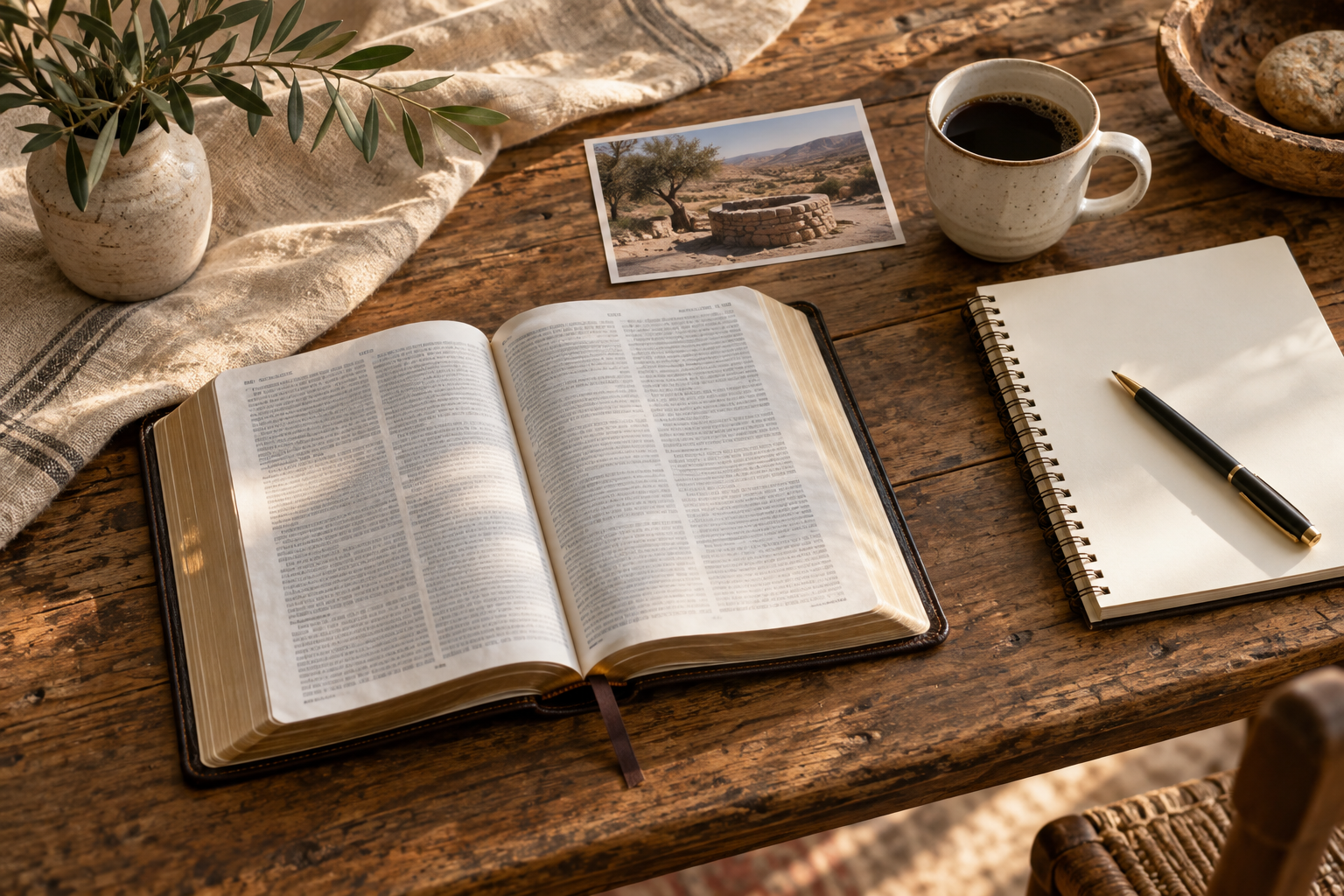
Primary passages: Genesis 16:1–16; Genesis 17:15–27; Genesis 21:1–21; Genesis 25:7–18. Compare: Genesis 15:13; Exodus 1:8–14; Exodus 3:7–10; Deuteronomy 10:17–19; Galatians 4:21–31.
Before We Begin
Pour the coffee, because Hagar’s story is short enough to fit inside two chapters and complicated enough to keep us at the table for a while. Most of us meet her as a supporting character in Abraham and Sarah’s story: Sarah cannot conceive, Hagar bears Abraham a son, conflict erupts, and eventually Hagar and Ishmael disappear into the wilderness. If we move too quickly, Hagar becomes little more than the woman who produced the son who was not Isaac.
Genesis does not let us get away with that. Hagar is Egyptian. She is enslaved in Sarai’s household. Other people make decisions about her body, her pregnancy, her place in the family, and finally whether she and her son may remain. Yet she is also the person whom the messenger of Yehovah finds in the wilderness, addresses by name, speaks promises over, and meets again when she believes her child is dying.
This study is not going to turn Sarah into a cartoon villain or Abraham into a monster so that Hagar can become the uncomplicated hero. Scripture is better than that. Sarah’s grief is real. Abraham’s covenant calling is real. Isaac’s place in the promise is real. Hagar’s mistreatment is also real. The text can hold all of those things at once, so we will too.
Our job is to follow Hagar through the story instead of borrowing conclusions from whichever character we already know best. We will pay attention to power, speech, names, seeing, hearing, affliction, promise, and wilderness. And when later Scripture uses Hagar symbolically, we will let that later argument speak without allowing it to erase the woman Genesis actually introduced us to.
PEOPLE-STUDY RULE
Do not flatten a biblical person into a lesson. Follow the person through the story, notice what the text says and what it leaves unsaid, compare later Scripture carefully, and let human beings in the Bible remain fully human.
Before reading further, what words or ideas immediately come to mind when you think of Hagar?
____________________________________________________________
____________________________________________________________
Whose story have you usually thought Genesis 16 and 21 were primarily telling?
____________________________________________________________
____________________________________________________________
Meet Hagar Before We Explain Her
Read Genesis 16:1–3 slowly. Hagar enters the story with three pieces of information attached to her: she belongs to Sarai’s household, she is Egyptian, and she is a shifhah—a female servant or slave. The story gives us no childhood, parents, marriage, hopes, or explanation of how an Egyptian woman came into this household. She appears because Sarai has a problem and Hagar’s body becomes part of the proposed solution.
That social position matters. Modern English translations vary between servant, maidservant, slave, and bondwoman, but we should not let a gentle English word hide the power imbalance in the Hebrew household. Hagar does not negotiate a surrogacy agreement with Sarai and Abram. Sarai gives her to Abram as a wife/concubine so that Sarai may be ‘built up’ through her. Genesis narrates the arrangement as something Sarai and Abram decide; Hagar’s consent is not narrated.
Ancient family-building practices help explain why Sarai’s proposal would have been intelligible in that world. They do not make every use of power morally neutral. Historical background can tell us why people acted as they did; it cannot make the vulnerable person disappear. The text repeatedly reminds us that Hagar is under someone else’s authority, and that fact shapes every scene that follows.
What does Genesis 16:1–3 explicitly tell you about Hagar’s status and nationality?
____________________________________________________________
____________________________________________________________
What decisions are made about Hagar before the text records Hagar speaking for herself?
____________________________________________________________
____________________________________________________________
____________________________________________________________
Sarai Has a Plan—and Abram Listens
Sarai begins with theology: ‘Yehovah has prevented me from bearing.’ Her pain is not imaginary. In the world of Genesis, children are tied to family continuity, inheritance, security, and the promises already spoken to Abram. Years have passed since the promise, and there is still no child through Sarai. Her proposal is an attempt to solve a real problem with a culturally recognizable strategy.
Genesis 16:2 says Abram listened to Sarai’s voice. That phrase is not automatically a condemnation; Scripture uses hearing language in many neutral and positive ways. But narratively, it matters that nobody pauses to ask whether Yehovah’s promise requires this solution. The promise in Genesis 15 has named Abram’s own offspring, but Sarah has not yet been explicitly named as the mother until Genesis 17. Human beings are trying to navigate an incomplete picture—and Hagar bears the cost of their decision.
This is one reason Hagar’s story resists tidy moral slogans. We cannot simply say, ‘They should have waited,’ and move on. Waiting is part of the story, but so are infertility, household power, cultural practices, and an enslaved woman whose reproductive capacity becomes the mechanism of somebody else’s hope. Good Bible study makes room for the whole scene.
What problem is Sarai trying to solve?
____________________________________________________________
____________________________________________________________
What does the passage say about Hagar’s participation in the decision?
____________________________________________________________
____________________________________________________________
What details should keep us from reducing this scene to a simple lesson about impatience?
____________________________________________________________
____________________________________________________________
____________________________________________________________
Pregnancy Changes the Household
Hagar conceives, and Genesis says her mistress becomes ‘light’ or diminished in her eyes. Many translations render this as despising or looking with contempt. Something in Hagar’s regard for Sarai changes after conception. The text does not give us Hagar’s internal monologue, so we should be careful about inventing one. She may be proud, resentful, newly aware of her value, openly contemptuous, or some mixture we cannot recover.
Sarai experiences that change as a wrong done to her. She turns to Abram, and Abram answers that Hagar is in Sarai’s hand: do to her what is good in your eyes. Then the narrator uses a strong verb—Sarai ‘afflicts’ or deals harshly with Hagar. The same Hebrew root, anah, will later describe Israel’s affliction in Egypt. Genesis therefore gives us a striking reversal: an Egyptian woman is afflicted in a Hebrew household and flees toward the wilderness; later Hebrew descendants will be afflicted in Egypt and cry out for deliverance.
That correspondence does not make Hagar identical to Israel, and Genesis never labels her flight an Exodus. But the shared language should make us uncomfortable with any reading that excuses her suffering simply because Sarah is part of the covenant family. Election does not turn mistreatment into righteousness. Scripture itself is willing to show covenant people behaving badly.
NOTICE THE VERB
Genesis uses the language of affliction for what Sarai does to Hagar. Later, the same Hebrew root describes the oppression of Israel in Egypt. The parallel should make us pay attention, not force a one-to-one allegory.
What does the text say changed after Hagar conceived?
____________________________________________________________
____________________________________________________________
What word does Genesis use for Sarai’s treatment of Hagar?
____________________________________________________________
____________________________________________________________
How does the later Egyptian oppression of Israel complicate the way we read an Egyptian woman being afflicted here?
____________________________________________________________
____________________________________________________________
____________________________________________________________
The Messenger Finds the Fugitive
Hagar flees. Then Genesis 16:7 says the messenger of Yehovah finds her by a spring in the wilderness on the way to Shur. Notice the direction of the action. Hagar does not go into the wilderness looking for a religious experience. She is running away. Yehovah’s messenger finds her there.
The messenger asks, ‘Hagar, Sarai’s servant, where have you come from, and where are you going?’ The title still names her social reality, but the address also gives us something the household scenes did not: her name. Sarai and Abram speak about her as ‘my servant’ or ‘your servant.’ The divine messenger speaks to Hagar directly. Then Hagar answers. For the first time in the story, we hear her voice: ‘I am fleeing from my mistress Sarai.’
The question is not asked because heaven lacks information. Throughout Scripture, divine questions often invite human beings to name their situation. Hagar can identify where she came from. She cannot answer where she is going. That may be one of the most painfully honest details in the chapter: she knows what she is escaping, but the story has not yet given her a safe destination.
Who finds whom in Genesis 16:7?
____________________________________________________________
____________________________________________________________
What is the first recorded sentence Hagar speaks?
____________________________________________________________
____________________________________________________________
Why might the unanswered “Where are you going?” matter?
____________________________________________________________
____________________________________________________________
The Hardest Sentence in the Story
Then comes the sentence we should not soften: the messenger tells Hagar to return to her mistress and submit herself under her hand. After the text has just told us Sarai afflicted her badly enough to make her flee, this command is hard. It should be hard. We do not honor Scripture by pretending difficult verses are easy.
Several explanations are commonly offered. Some readers argue that returning to the household was the only realistic route to survival for a pregnant woman alone in that wilderness and that the command comes with a promise of protection and descendants. Others emphasize the ancient household structure and the narrator’s interest in keeping Hagar and Ishmael connected to Abraham’s line. Still others focus on how troubling the command remains, especially in communities where enslaved or abused people have historically been told to return to danger in the name of obedience.
What can we say without pretending to know what the text does not tell us? The command is there. The prior affliction is also there. The messenger does not call Sarai’s harsh treatment righteous. The promise to Hagar does not erase the harm she suffered. And this one command to Hagar in one narrative must never be converted into a general rule that Yehovah requires abused people to return to unsafe situations. Narrative description and a specific divine instruction are not automatically universal policy.
This is one of those places where good interpretation requires moral seriousness and textual restraint at the same time. We may still have questions after reading faithfully. Scripture does not promise that every hard story will become emotionally comfortable once we know a few Hebrew words.
What exactly does the messenger command Hagar to do?
____________________________________________________________
____________________________________________________________
What does the passage NOT say about Sarai’s prior treatment of Hagar?
____________________________________________________________
____________________________________________________________
Why would it be dangerous to turn this specific command into a universal instruction for people experiencing abuse?
____________________________________________________________
____________________________________________________________
____________________________________________________________
Hagar Receives a Promise of Her Own
The messenger does more than send Hagar back. He promises to multiply her offspring beyond counting. That wording deliberately echoes the abundance promises surrounding Abram. Hagar will not carry the covenant line that will proceed through Isaac, but she is not outside Yehovah’s attention or blessing. Her son matters to Him.
The messenger tells her she will bear a son and name him Ishmael—Yishma’el—because Yehovah has heard her affliction. The name itself carries hearing: God hears. Before Ishmael is born, his name becomes a testimony that Hagar’s suffering has not gone unnoticed.
The description of Ishmael in Genesis 16:12 is often translated ‘a wild donkey of a man.’ That sounds insulting in modern English, but the wild donkey was an untamed desert animal, outside domestic control. The image likely points toward fierce independence and a life beyond easy subjection, though the following lines also anticipate conflict among kin. We should avoid turning a poetic birth oracle into an ethnic insult against Ishmael’s descendants.
What promise is given directly to Hagar?
____________________________________________________________
____________________________________________________________
Why is the child to be named Ishmael?
____________________________________________________________
____________________________________________________________
How does the promise complicate a simple “chosen family versus forgotten outsider” reading?
____________________________________________________________
____________________________________________________________
____________________________________________________________
Hagar Names the God Who Saw Her
Then Hagar does something extraordinary. Genesis says she calls the name of Yehovah who spoke to her El Ro’i. English translations usually give us something like ‘God who sees me,’ ‘God of seeing,’ or ‘God who sees.’ The Hebrew expression and Hagar’s explanation in the rest of verse 13 are famously difficult, so we should not build an entire doctrine on one perfectly certain English gloss.
But the seeing motif itself is unmistakable. Hagar has been treated as useful property, then as a problem, then as someone who can be sent away. In the wilderness she discovers that Yehovah sees. And the location receives a name connected to the Living One who sees. Her experience becomes attached to geography: a well in the wilderness now remembers that the runaway was not invisible.
There is a beautiful tension in the verse: seeing can work in both directions. Is He the God who sees her? The God whom she has seen? The Hebrew can support discussion around both ideas. We do not need to squeeze the phrase until only one devotional slogan remains. What the narrative unquestionably gives us is encounter: the unseen woman is met by the God who knows where she is.
And notice who receives this encounter. Hagar is Egyptian, female, enslaved, pregnant, and outside the line through which Isaac will later carry the covenant promise. None of those facts keep Yehovah from finding her, speaking to her, promising her descendants, hearing her affliction, and allowing her response to become part of Scripture.
DO NOT TURN EL RO’I INTO A MAGIC GLOSS
The Hebrew phrase is compact and its exact nuance is debated. The narrative emphasis is still clear: Hagar’s encounter is saturated with seeing, being seen, and surviving an encounter with the living God.
What name does Hagar use for Yehovah in Genesis 16:13?
____________________________________________________________
____________________________________________________________
What “seeing” ideas do you notice across verses 13–14?
____________________________________________________________
____________________________________________________________
____________________________________________________________
What changes when we read Hagar as a person Yehovah addresses directly rather than merely as part of Abraham’s problem?
____________________________________________________________
____________________________________________________________
____________________________________________________________
She Returns—and Ishmael Is Born
Hagar returns, and Ishmael is born. Abram names him Ishmael, which means the divine word Hagar received is carried into the household. Genesis 17 then makes the covenant line through Sarah and Isaac explicit. Yehovah changes Sarai’s name to Sarah, promises that she herself will bear a son, and says the covenant will be established with Isaac.
But Abraham immediately asks about Ishmael: ‘Oh that Ishmael might live before You.’ Yehovah answers both with distinction and blessing. Isaac will carry the covenant identified in this passage; Ishmael will also be blessed, made fruitful, multiplied greatly, and father twelve princes. Scripture does not require us to erase one son in order to honor the other.
That distinction is crucial for the rest of Hagar’s story. Isaac’s election is real. Ishmael’s blessing is also real. Election in Genesis is not the same thing as saying everyone outside the chosen line is hated, worthless, or abandoned by God. The text refuses that shortcut.
What is promised specifically through Isaac in Genesis 17?
____________________________________________________________
____________________________________________________________
What is promised specifically concerning Ishmael?
____________________________________________________________
____________________________________________________________
Why is it important to preserve both distinction and blessing?
____________________________________________________________
____________________________________________________________
____________________________________________________________
Genesis 21: The Story Hurts Again
Years pass. Sarah gives birth to Isaac, laughter fills the household, and at Isaac’s weaning feast Sarah sees the son of Hagar doing something described by the Hebrew participle metsacheq. Translations vary: playing, laughing, mocking. The word is built from the same laughter root behind Isaac’s name, Yitzchaq. The text does not give us enough detail to be dogmatic about exactly what Ishmael was doing.
Sarah’s stated concern, however, is clear: inheritance. She tells Abraham to drive out ‘this slave woman and her son,’ because Hagar’s son will not inherit with Isaac. Notice the loss of names in Sarah’s speech. Hagar becomes ‘this slave woman.’ Ishmael becomes ‘her son.’ The language creates distance at the moment Sarah demands their removal.
Abraham is deeply distressed because Ishmael is his son. Yehovah tells him not to be distressed over the boy and Hagar, affirms that the covenant line will be called through Isaac, and again promises to make a nation of Ishmael because he is Abraham’s offspring. Then Abraham sends Hagar and the boy away with bread and water.
The story does not ask us to pretend this is emotionally neat. Divine election and human expulsion occupy the same paragraph. The text protects Isaac’s covenant role while also making us walk into the wilderness with Hagar.
What does Sarah explicitly say she fears in Genesis 21:10?
____________________________________________________________
____________________________________________________________
What details in the passage show Abraham’s relationship to Ishmael?
____________________________________________________________
____________________________________________________________
What promise does Yehovah repeat before Hagar and Ishmael are sent away?
____________________________________________________________
____________________________________________________________
When the Water Is Gone
Hagar wanders in the wilderness of Beersheba until the water is gone. She places the boy under a shrub, moves away, and says she cannot watch the child die. Then she weeps. Genesis slows down enough for us to sit with a mother who has reached the end of what she can provide.
And then the hearing motif returns. God hears the voice of the boy. The messenger calls to Hagar from heaven: ‘What troubles you, Hagar? Do not fear.’ Once again she is addressed by name. Once again the promise concerning Ishmael is repeated. Once again the wilderness becomes the place where divine attention interrupts despair.
Then God opens Hagar’s eyes and she sees a well of water. The text does not say the well was miraculously created at that moment. It says her eyes are opened and she sees it. Whether the emphasis is miraculous provision, newly perceived provision, or both, the narrative deliberately returns to seeing. In Genesis 16 Hagar names the God who sees. In Genesis 21 Hagar herself is enabled to see what preserves life.
The story ends this scene not with Hagar returning to Sarah but with God being with Ishmael. He grows in the wilderness, becomes an archer, lives in Paran, and Hagar secures an Egyptian wife for him. The enslaved Egyptian woman who entered Genesis as somebody else’s property exits this episode acting as a mother shaping her son’s future.
SEEING AND HEARING
Genesis 16: Yehovah hears Hagar’s affliction and Hagar speaks of seeing. Genesis 21: God hears Ishmael, addresses Hagar, and opens her eyes to see water. The repeated verbs are part of the story’s theology.
Whose voice does Genesis 21:17 say God hears?
____________________________________________________________
____________________________________________________________
What does the messenger say to Hagar before she sees the well?
____________________________________________________________
____________________________________________________________
What changes in Hagar’s circumstances after God opens her eyes?
____________________________________________________________
____________________________________________________________
____________________________________________________________
The Wilderness Does Not Mean Absence
Hagar meets Yehovah in places nobody would choose as a spiritual retreat. The first wilderness scene begins with abuse. The second begins with expulsion. Neither crisis is romanticized. Scripture does not tell us to be grateful for mistreatment because suffering produced a meaningful encounter.
At the same time, the wilderness repeatedly becomes the location where Hagar learns that abandonment by people is not abandonment by God. That pattern will echo later in Israel’s story, in Elijah’s story, in David’s flights, and throughout the biblical imagination. Wilderness can expose human vulnerability without placing a person beyond divine reach.
That distinction matters pastorally. ‘God met Hagar in the wilderness’ must never become ‘therefore the people who drove her there were doing God’s will in everything they did.’ Providence is not retroactive moral approval. Yehovah can bring life in a place created by human failure without baptizing the failure itself.
What caused each of Hagar’s two wilderness experiences?
____________________________________________________________
____________________________________________________________
What does Yehovah do in each wilderness scene?
____________________________________________________________
____________________________________________________________
____________________________________________________________
Why is divine provision not the same thing as divine approval of every human action that preceded it?
____________________________________________________________
____________________________________________________________
____________________________________________________________
Hagar, Sarah, and the Danger of Choosing a Team
Readers often feel pressure to defend one woman by prosecuting the other. If we identify with Sarah’s infertility and long waiting, we may minimize what happened to Hagar. If we identify with Hagar’s powerlessness, we may flatten Sarah into cruelty and forget the pain and promise surrounding her. Genesis gives us enough truth to resist both moves.
Sarah is a matriarch of Israel and a recipient of Yehovah’s promise. She is also capable of using power harshly. Hagar is mistreated and receives divine compassion. She is also described as looking on Sarah with diminished regard after conceiving. The narrator does not need either woman to be morally flawless in order for her suffering, choices, and encounter with God to matter.
This is one of the gifts of biblical narrative: Scripture is often less interested in protecting our heroes than we are. Covenant people can fail. Vulnerable people can be complicated. God’s faithfulness does not depend on our ability to turn every human being into either a saint or a villain.
Where have you been tempted to excuse one character because you identify with her pain?
____________________________________________________________
____________________________________________________________
What becomes clearer when you let both Sarah’s grief and Hagar’s mistreatment remain true?
____________________________________________________________
____________________________________________________________
____________________________________________________________
What About Galatians 4?
Later, Paul uses Sarah and Hagar in Galatians 4:21–31 as an allegorical argument. He connects the two women with two covenants and contrasts slavery with freedom within his urgent dispute over the Galatians’ relationship to Torah, circumcision, promise, and Messiah. Whatever conclusions we reach in Galatians, we need to notice what Paul is doing: he is using characters from Genesis symbolically inside a different argument.
An allegorical use does not retroactively replace the Genesis narrative. Hagar the literary symbol in Galatians is still Hagar the Egyptian woman in Genesis. Paul’s metaphor does not tell us that Hagar was spiritually inferior, that Yehovah did not care for her, or that her suffering was deserved. Genesis remains the source story, and it repeatedly portrays divine seeing, hearing, promise, and provision toward her and Ishmael.
This matters because later theological use can become so familiar that it overwrites the person. A People of the Bible study should reverse that habit. First know Hagar as Genesis tells her story. Then ask what Paul is doing when he recruits that story rhetorically. Do not make Paul erase Moses, and do not make Moses erase Paul.
What does Paul explicitly say he is doing with the women in Galatians 4:24?
____________________________________________________________
____________________________________________________________
What would be lost if Galatians 4 became the only lens through which we read Hagar?
____________________________________________________________
____________________________________________________________
____________________________________________________________
Test the Things We Say About Hagar
Now let’s put several familiar claims on the table and ask whether Genesis actually carries their weight.
“Hagar was basically a willing surrogate.”
The text describes an enslaved woman whose mistress gives her to Abram. It does not narrate negotiation or consent. Historical custom explains the arrangement; it does not let us insert voluntary agreement that the text never gives us.
“Sarah was simply jealous.”
Jealousy may be part of the emotional picture, but Genesis gives us more specific issues: infertility, Hagar’s changed regard, household power, and later inheritance. “Jealous” alone is too thin.
“Hagar despised Sarah, so Sarah’s treatment was justified.”
Hagar’s regard changes, but the narrator still uses strong affliction language for Sarai’s treatment. One wrong does not automatically sanctify another.
“God sent Hagar back, so abused people should return and submit.”
That turns one specific narrative command into a universal rule the passage never states. It is a dangerous inference, especially when Scripture elsewhere condemns oppression and commands protection of the vulnerable.
“Isaac was chosen, so Ishmael was rejected by God.”
Isaac carries the covenant line, but Ishmael repeatedly receives blessing, descendants, divine hearing, protection, and the statement that God was with him.
“El Ro’i simply means ‘the God who sees me,’ case closed.”
That is a legitimate and beautiful rendering, but the Hebrew expression and Hagar’s explanation are compact and debated. The seeing theme is certain; every lexical nuance is not.
“Hagar is only important because Paul uses her in Galatians.”
Genesis gives Hagar an encounter, speech, promise, naming, motherhood, and a future long before Paul’s allegory. Her narrative significance does not depend on becoming a later symbol.
TEXT and INFERENCE
One of the best ways to keep ourselves honest is to separate what Genesis states from what we infer.
TEXT — explicit or strongly textual | INFERENCE — possible, but requires argument |
|---|---|
Hagar is Egyptian and Sarai’s shifhah. | How Hagar originally entered the household. |
Sarai gives Hagar to Abram; Hagar’s consent is not narrated. | Exactly what Hagar felt about the arrangement. |
Sarai afflicts Hagar and Hagar flees. | The full form or severity of the mistreatment beyond the verb used. |
The messenger tells Hagar to return. | Every reason behind that command. |
Yehovah hears Hagar’s affliction and promises descendants. | A universal promise that every suffering person will receive the same earthly outcome. |
Isaac carries the covenant line; Ishmael is also blessed. | That covenant election means God has no purpose or care for anyone outside that line. |
God hears Ishmael and is with him. | Everything Ishmael’s later descendants will do or represent. |
Paul uses Hagar allegorically in Galatians 4. | That the Genesis story itself should be read only as Paul’s later allegory. |
Coffee Break With Sasha
Okay. Coffee refill. Because this story has managed to give us infertility, reproductive power, household hierarchy, slavery, ethnic difference, abuse, two wilderness scenes, a disputed Hebrew divine name, inheritance law, covenant election, and Paul’s allegory before we have even finished the mug. Hagar apparently did not get the memo that supporting characters are supposed to stay simple.
And this is exactly why I love actually opening the Bible. We inherit little summaries: Sarah’s maid. Ishmael’s mother. The woman sent away. Then you read the chapters and realize Yehovah finds her twice, speaks to her directly, gives her a promise, names her son around the fact that He heard her affliction, and makes sure the story remembers the well where she discovered she had been seen.
Also, can we retire the habit of making biblical women audition for Team Good Woman or Team Bad Woman? Sarah can be the promised matriarch and still misuse power. Hagar can be wrong in how she regards Sarah and still be genuinely oppressed. If your theology requires every person on your side of the covenant to behave beautifully at all times, Genesis is going to ruin your afternoon.
The better question is not, ‘Which woman am I supposed to defend?’ It is, ‘What is the text showing me about people, power, promise, and Yehovah?’ That question leaves a lot more room for truth—and usually requires more coffee.
What Hagar’s Story Can—and Cannot—Prove
What the story strongly shows
• Yehovah’s attention is not limited by nationality, sex, social rank, or household status.
• Covenant people can misuse power; belonging to the promised family does not make every action righteous.
• Isaac’s covenant election and Ishmael’s genuine blessing coexist in Genesis.
• Yehovah sees affliction, hears cries, speaks promises, and provides in the wilderness.
• Hagar is treated as a person with a name, voice, encounter, promise, and future—not merely as a reproductive device in someone else’s story.
What the story does not prove by itself
• That every suffering person will be removed immediately from harmful circumstances.
• That a specific command to Hagar requires abused people generally to return to danger.
• That Ishmael and Isaac occupy identical covenant roles.
• That every later conflict involving Ishmael’s descendants can be read directly back into these chapters.
• That one English gloss of El Ro’i settles every lexical question in Genesis 16:13.
• That Paul’s Galatians 4 allegory exhausts Hagar’s meaning in Genesis.
Your Turn: Follow Hagar Through the Story
Where does Hagar have the least human power in the story?
____________________________________________________________
____________________________________________________________
____________________________________________________________
Where do you see Hagar gaining voice, agency, or a future?
____________________________________________________________
____________________________________________________________
____________________________________________________________
What does the repetition of seeing and hearing teach you about Yehovah’s attention?
____________________________________________________________
____________________________________________________________
____________________________________________________________
What part of Hagar’s story became more complicated for you after reading the whole narrative?
____________________________________________________________
____________________________________________________________
____________________________________________________________
What conclusion can you state confidently from the text? What question are you willing to leave open?
____________________________________________________________
____________________________________________________________
____________________________________________________________
____________________________________________________________
Final Thought
Hagar enters Abraham’s story because other people decide what her body can do for their future. She runs because the household becomes unbearable. She is sent away when her son becomes a threat to somebody else’s inheritance. If that were all Genesis told us, she could disappear as easily as vulnerable people often disappear from official family stories.
But Yehovah finds her in the wilderness. He hears affliction. He speaks her name. He promises a future for the child in her womb. Years later, when water is gone and Hagar cannot bear to watch her son die, heaven speaks her name again. Her eyes open. There is water. The boy lives. God is with him.
Isaac still matters. The covenant promise still matters. Sarah still matters. Abraham still matters. Hagar’s story does not require us to diminish any of them. It asks us to notice that the God working through the promised line is not blind to the woman standing outside its center.
So when the story makes you uncomfortable, do not rush to rescue your favorite character. Stay with the text. Follow Hagar into the wilderness. Listen for what Yehovah hears. Look for what He sees. And do not assume that the person pushed to the edge of the human story has been pushed to the edge of His attention.
◆
Sources and Study Notes
Genesis 16; 17; 21; 25. Primary narrative texts for Hagar, Ishmael, Isaac, covenant distinction, blessing, and later genealogy.
Galatians 4:21–31. Paul’s later allegorical use of Hagar and Sarah; treated as a later rhetorical interpretation rather than a replacement for the Genesis narrative.
John Goldingay, Genesis (Baker Academic, 2020). Useful discussion of Genesis 16, including El Ro’i and the seeing language.
Nahum M. Sarna, Genesis, JPS Torah Commentary (Jewish Publication Society, 1989). Helpful for Hebrew wordplay, narrative setting, and the names associated with Hagar’s wilderness encounter.
Phyllis Trible, Texts of Terror (Fortress Press, 1984). Influential close reading of Hagar’s affliction, powerlessness, and divine encounter.
Yale Bible Study, “Sarah” and “Abraham and Isaac” study guides. Useful discussion of household power, ancient family-building practice, Hagar’s status, and the moral tension of Genesis 16 and 21.
Beth E. Elness-Hanson, “Hagar and Epistemic Injustice: An Intercultural and Post-colonial Analysis of Genesis 16,” Old Testament Essays 34.2 (2021). Helpful analysis of naming, voice, and marginalization in Hagar’s story.
Working Preacher (Luther Seminary), commentaries on Genesis 21:8–21 and Genesis 22. Helpful attention to Hagar/Ishmael, seeing/hearing motifs, and the literary relationship between the Hagar and Isaac narratives.
TheTorah.com, studies on Hagar and El Ro’i. Useful for philological discussion of Genesis 16:13 and the difficulty of translating the seeing language with false precision.
Open Your Bible
Don’t take my word for it. Read Genesis 16 and 21 again. Circle every reference to seeing, hearing, affliction, naming, promise, and wilderness. Then ask what the story actually says before deciding what Hagar is allowed to mean.
EXPLORE MORE PEOPLE OF THE BIBLE →Back to Top ↑