Before Titus 2 Tells Her What to Teach, It Tells Her Who to Become
Titus 2 is often approached as though Paul begins with a curriculum for women: love your husbands, love your children, be self-controlled, be pure, work faithfully within the household, be kind, live with godly order. There are important things to study in those instructions, including questions of translation, historical setting, household responsibilities, and what faithful application looks like across different circumstances. But Paul does not actually begin with the younger woman. He begins with the older one.
She is to be reverent in behavior. She is not to be slanderous. She is not to be enslaved. She is to teach what is good. Only then does Paul move into what she passes on to younger women. That order matters because before Paul asks an older woman to shape somebody else, he asks her to examine the woman doing the shaping.
That is deeply inconvenient if we would rather disciple girls by handing them rules. Rules are much easier than examples. A rule can say, Speak kindly. An example requires the girl to hear how you speak about the woman who irritates you. A rule can say, Do not gossip. An example requires her to notice what happens after company leaves and the front door closes. A rule can say, Your worth does not come from your appearance. An example requires her to hear how you speak about your own body when you look in the mirror. A rule can say, Trust Yehovah. An example requires her to watch what happens to your faith when life does not go according to plan.
That is why Titus 2 discipleship begins with character. Before we ask, "What should I teach her?" perhaps the better question is, "What is she already learning by watching me?" That one could keep us occupied through an entire pot of coffee.
She Is Already Being Discipled
We sometimes speak about discipling children as though spiritual formation happens during designated spiritual moments: Bible study, prayer, congregational gatherings, family devotions. Those things matter enormously, but children are observant little theologians with absolutely no respect for our lesson plans. They watch everything.
A girl hears you tell her that beauty comes from within, and then she watches you stand before the mirror saying, "I look disgusting." She hears that a woman's worth does not depend upon a man, then notices that every conversation about her future somehow ends with whether she will marry. She hears that kindness matters, then watches women tear one another apart in the car on the way home from worship. She hears that Scripture is authoritative, but notices that you rarely open it yourself unless someone else is teaching. She may not yet possess the vocabulary for the contradiction, but she notices.
Children learn our functional theology long before they can explain our stated theology. They learn what we really believe matters by watching what makes us ashamed, jealous, proud, fearful, impressed, angry, or desperate for approval. Tell a girl that Yehovah is enough while living as though everybody else's opinion determines your peace, and she learns something. Tell her she may ask questions while becoming defensive every time she asks one you cannot answer, and she learns something else.
We are always teaching. The only question is whether we know what lesson we are giving.
Before the World Tells Her Who She Is
The world will not wait politely while we decide when our daughters are old enough to discuss identity. It begins early. Sometimes ridiculously early. Entire industries depend upon convincing girls that something about them is insufficient. Their skin needs fixing. Their hair needs fixing. Their weight needs fixing. Their clothes need upgrading. Their popularity needs measuring. Their lives need documenting. Apparently their faces may require professional lighting before ninth grade.
Then adolescence arrives, and the messages get louder. Be beautiful, but do not look vain. Be desirable, but do not appear to want attention. Be confident, but not intimidating. Be intelligent, but not in a way that makes anybody uncomfortable. Be independent, but make sure someone chooses you. Be thin, but effortless about it. Be interesting, agreeable, successful, wanted, watched, approved.
That is an exhausting little kingdom to live in. And if a girl has not been given something sturdier beneath her feet, she will eventually begin measuring herself in whatever currency the people around her seem to value: beauty, attention, popularity, romance, achievement, usefulness, marriage, motherhood. None of those things is large enough to carry her identity.
Before Anybody Else Names Her, She Belongs to the King
A girl should not have to wait until adulthood to learn what grown women often spend years trying to recover: your roles are not the deepest truth about you. She may someday become a wife. Wonderful. She may become a mother. Beautiful. She may become an engineer, teacher, farmer, nurse, accountant, writer, artist, homemaker, business owner, or something none of us have imagined yet. Those things may become meaningful parts of her life, but they are not the foundation underneath it.
Before anyone hires her, marries her, follows her, admires her, depends upon her, desires her, or calls her Mom, she belongs to Yehovah. For the girl who belongs to Messiah, Scripture gives an identity far more durable than social approval. She is part of His household and His people, a recipient of His Spirit and an heir according to promise. Calling her a daughter of the King should therefore mean far more than decorating her bedroom with crowns and telling her she is a princess.
It means she belongs to Someone. It means her life has an authority above the opinions of everyone in the room. Her body is not currency. Her beauty is not a bargaining chip. Sexual attention does not establish her value. A boy wanting her does not increase her worth, and a boy overlooking her does not reduce it. Being chosen romantically does not transform her into something more valuable than she was five minutes earlier. A wedding ring cannot complete an identity that was never incomplete.
Motherhood, should Yehovah give it to her, may become one of the most sacred roles she ever carries. It still will not become the source of her personhood. Achievement can be stewarded; it cannot tell her what she is worth. Beauty can be appreciated; it cannot become her god. Before the world tells her what she must become to matter, teach her whose she already is.
Raise Her for the Kingdom, Not Merely for Marriage
There is something we need to say carefully because it will make some people uncomfortable: we should not raise little girls merely to become desirable wives. We should raise them to become faithful women. If Yehovah gives her a husband someday, faithfulness will shape the kind of wife she becomes. If He gives her children, faithfulness will shape her motherhood. But marriage preparation cannot become the outer boundary of female formation because Scripture does not promise every girl a husband, and Yehovah's purposes for a woman do not suddenly switch on when someone places a ring on her finger.
Teach her how to build a home. Teach her how to cook if you know how. Everybody should know how to feed themselves; civilization depends upon it. Teach hospitality, budgeting, household management, caring for others, generosity, patience, and the thousand practical skills that make daily life function. But also teach her how to read a contract. Teach her what interest costs. Teach her to recognize manipulation. Teach her basic maintenance. Teach her to grow tomatoes. Teach her how to research something before believing the loudest person in the room.
Teach her how to apologize when she is wrong and how to say no when she is not. Teach her how to comfort someone without making the other person's grief about herself. Teach her how to recognize danger, how to leave a room when necessary, how to admit "I don't know," and how to learn what she does not yet understand. None of these things threatens femininity. They prepare a woman for life.
Most importantly, teach her Scripture well enough that she does not require somebody else to tell her what Yehovah said every time a theological question arises. Marriage preparation is good. Kingdom preparation is bigger.
Teach Her Scripture Before Somebody Uses It Against Her
This may be one of the most sacred responsibilities we have toward girls. Teach them the Bible, but do not stop with Bible stories. Teach them how to read it. Teach them that a verse has a paragraph around it, a chapter around that, a book around that, and an entire biblical story surrounding all of it. Teach genre and audience. Teach them to distinguish between something Scripture reports and something Scripture commands. Teach them the difference between what a passage explicitly says and what someone has inferred from it.
Teach them that asking "Where does it say that?" is not rebellion. Teach them that context matters and that Scripture should be compared with Scripture. Teach them enough biblical literacy that if someone someday takes a verse about submission, authority, forgiveness, suffering, modesty, obedience, or anything else and uses it to demand something Yehovah never required, a little alarm sounds inside her mind: Wait. Is that actually what the passage says?
That may protect her in ways you cannot imagine when she is twelve. Theological ignorance does not make a woman submissive. It makes her vulnerable. A girl who knows Scripture can still be deceived - we all can - but she possesses tools. She knows where to look. She knows she is allowed to open the Bible herself instead of assuming that confidence equals correctness.
And if someone becomes irritated that she knows enough Scripture to recognize when he is misusing it? Well. Perhaps that is useful information too.
Teach Her Competence Without Teaching Her She Must Prove Herself
I want Kingdom daughters to become competent women, not because competence earns value but because competence is stewardship. If she has a capable mind, teach her to use it. If she is artistic, give her room to create. If she loves numbers, do not treat that as an amusing anomaly. If she wants to know how machinery works, hand her the wrench. If she loves books, keep feeding the addiction responsibly. If she asks seventeen questions about one verse, answer fourteen and make coffee before tackling the final three.
Help her discover what Yehovah placed in her hands, but be equally careful not to create a girl who thinks she must constantly prove that she is as good as men, prettier than other girls, smarter than her classmates, more spiritual than her friends, or exceptional enough to deserve love. She does not need to win womanhood. She already possesses dignity.
Teach her to work hard without turning achievement into a god. Let her fail at things without turning failure into a verdict about her worth. Let her discover that being bad at something is often just the irritating first stage of becoming competent at it. A B on the test is information, not an identity crisis. Neither is being cut from the team. Neither is being overlooked. Neither is another woman being better at something. She does not need to be the best woman in the room to be a faithful one.
Modesty Is Bigger Than a Hemline
We should teach girls modesty. We should also make sure we actually know what we mean by it, because biblical modesty is much larger than clothing. Clothing can express modesty, but modesty reaches into conduct, attitude, speech, self-presentation, humility, self-control, discretion, and the way we seek attention. A woman can be covered from collarbone to ankle and still behave immodestly. She can be boastful, vulgar, intentionally provocative, obsessed with status, desperate to be noticed, cruel in speech, or constantly displaying what she owns and whom she knows. Fabric alone cannot make a person modest.
Biblical modesty teaches us not to build our identity around being looked at. That is especially important for girls growing up in a culture that can turn sexual attention into social currency. We need to tell them plainly: your value does not come from being sexually desirable. Attention from men does not prove that you are beautiful enough, feminine enough, mature enough, or worth loving. The number of people who want access to your body has absolutely nothing to do with the worth of the person living inside it.
That means teaching a girl to dress with wisdom does not require teaching her that her body itself is shameful. There is a devastating difference between saying, "Your body has dignity, so carry and present yourself with honor," and saying, "Your body is dangerous, so make sure nobody notices you." One produces stewardship. The other can produce shame.
A developing girl should not learn that breasts are embarrassing, femininity is hazardous, or male behavior is somehow hers to manage. Another person's thoughts and actions remain that person's moral responsibility. We can teach appropriateness, discretion, privacy, self-respect, and sexual boundaries without making a girl feel that simply inhabiting a female body is a spiritual liability.
And modesty should reach far beyond sexuality. Teach her not to make wealth her identity. Not to flaunt possessions for status. Not to dominate every conversation. Not to tell another person's private story for attention. Not to perform goodness so everyone notices how good she is. Not to build an online life around needing strangers to validate her. Teach her that sometimes modesty means choosing not to advertise everything about herself simply because she can.
Modesty is not making yourself invisible. It is refusing to make attention your source of value. Her body has dignity. Her sexuality has boundaries. Her behavior should reflect the King she represents. But sexual attention is not her worth, and modesty is far more than what she wore when somebody looked at her.
Gentleness Without Helplessness
Teach girls gentleness. The fruit of the Spirit matters for girls exactly as it matters for boys, and gentleness is beautiful. But somewhere along the way, gentleness has occasionally been confused with helplessness, and they are not the same thing.
A gentle woman can know exactly what she thinks. She can say no. She can recognize manipulation, leave an unsafe situation, confront sin, ask difficult questions, and know Scripture better than the person arguing with her. She can be extraordinarily strong because gentleness is not the absence of strength. It is strength governed by character.
Teach her that kindness does not require becoming easy to exploit. Forgiveness does not require immediate trust. Loving someone does not give that person unlimited access to her. Being a peacemaker does not mean becoming the person who must surrender every time somebody else becomes angry. Teach her to remain softhearted without becoming spineless. Gentle does not mean small.
Respect Without Subjugation
Teach her to respect men, and teach her to respect women too. Teach her to honor parents, elders, teachers, legitimate authority, wise congregational leadership, employers, and other human beings because people should not be casually dehumanized. But do not teach her that respect requires assuming a man is automatically wiser because he is male.
Do not teach her that disagreement with a man is inherently disrespectful, that competence becomes threatening when hers exceeds his, or that a future husband will become her mediator with Yehovah. Do not train her to confuse male approval with divine approval. There will be men in her life whose wisdom deserves her attention. There will also be men who are wrong. Those statements can coexist peacefully.
Teach her to listen without surrendering discernment, receive correction without becoming easily controlled, and practice humility without pretending ignorance. Teach her to recognize healthy authority so that counterfeit authority becomes easier to spot. A woman who understands respect without subjugation can sit under wise leadership without disappearing beneath it. That is a very different thing.
Teach Her the Difference Between Attention and Love
One day someone will notice her. Maybe she will be thirteen, sixteen, or twenty-five. Someone may tell her she is beautiful. Someone may make her feel special. Someone may inform her that nobody has ever understood him the way she does after knowing her for eleven days. This is where I would very much like our daughters to have a functioning discernment system.
Sexual and romantic attention can feel powerful, particularly to a girl who has learned to use attention as evidence of worth. That is why we need to tell her long before the first persuasive teenage boy arrives that attention is not love. Desire is not commitment. Possessiveness is not protection. Jealousy is not devotion. Control is not leadership. Intensity is not intimacy. Someone wanting access to her does not necessarily mean he values her.
Teach her to watch character. How does he behave when he is angry? Can he accept no? Does he honor boundaries that frustrate him? How does he speak about women who have nothing to offer him? Does he lie? Does he manipulate? Can he accept correction? Does he take responsibility when he causes harm? Does he love Yehovah only when adults are watching? Does his life produce fruit?
We can spend eighteen years teaching girls what a godly husband supposedly looks like while spending remarkably little time teaching them how to recognize an ungodly man before he becomes one. That seems like a curriculum problem.
Let Her Ask Questions
Please let her ask questions, even the awkward ones. Especially the awkward ones. If she asks why Yehovah commanded something, do not immediately interpret why as rebellion. Perhaps she wants to understand. If she discovers something in Scripture that troubles her, do not teach her to fear the discomfort. Sit with it. Read it. Study it together.
And say "I don't know" when you do not know. That may be one of the most important things she ever hears an older woman say: I don't know. Let's find out. You are teaching her that faith does not require adults to pretend certainty. You are teaching her that Scripture can withstand examination, that Yehovah is not intimidated by sincere questions, and that a mature woman can be teachable without becoming gullible.
Some girls will be naturally compliant. Others seem to arrive on earth prepared to cross-examine Moses personally. Yehovah can sanctify both. Do not crush the questioner until she becomes easier to manage. Teach her how to ask better questions. One day the same instinct that made bedtime exhausting may protect her from false doctrine. You are welcome.
Teach Her to Recognize Yehovah's Voice Without Calling Every Feeling His Voice
We want girls to know Yehovah personally, but that also means teaching discernment. Not every strong feeling is the Ruach. Not every coincidence is a sign. Not everyone who says "God told me" heard from God. Not every opportunity is a calling. Not every closed door is spiritual warfare. And not every Bible verse encountered randomly five minutes after asking a question is necessarily Yehovah's personalized telegram.
Teach her to recognize His voice by becoming deeply familiar with what He has already spoken. Scripture becomes the grammar of discernment. Prayer matters. Wisdom matters. Counsel matters. Fruit matters. Time can matter. Circumstances can matter. But none of them gives us permission to contradict what Yehovah has already revealed.
We are not merely trying to raise girls who say, "I feel like God wants me to..." We are raising women capable of asking, "Is this consistent with the character and instruction of the Yehovah I have come to know in Scripture?" That is a much sturdier faith.
The Kingdom Needs Aunties
Titus 2 cannot belong only to biological mothers because Paul is describing women forming women. The Kingdom needs mothers and grandmothers, and for the love of all things good, the Kingdom needs aunties.
Not merely biological aunties. Kingdom aunties. Women who notice the teenage girl sitting alone and sit beside her. Women who remember what fifteen felt like. Women who can teach a young mother something without making her feel like an incompetent child. Women who invite younger women into their homes and let them discover that adulthood is mostly everybody figuring things out with slightly better cookware.
These are women who say, Come over. I'll show you. Come learn to bake the bread. Come learn to read the passage. Come learn to balance the budget. Come plant the garden. Come learn what healthy conflict looks like. Come learn to host people. Come learn how to research that Greek word without believing the first website you found. Come cry. Come laugh. Come ask the question you were embarrassed to ask. Come watch me apologize when I am wrong.
That is Titus 2 too. Titus 2 is how women make sure every generation does not have to learn womanhood from scratch.
Age Alone Does Not Make Advice Wise
There is an uncomfortable side to generational discipleship. Older women have something to give younger women, but age does not automatically sanctify everything we learned along the way. We can pass down wisdom. We can also pass down fear, body shame, people-pleasing, competition, unhealthy marriage patterns, misogyny, bad theology, family dysfunction, and rules Yehovah never made.
A woman can hand a younger woman the very chains she spent decades wearing and call them an inheritance. That is why Titus 2 does not merely say older women should teach. It says they should teach what is good. That qualifier matters. Before we hand something to the next generation, perhaps we should inspect it. Is this Scripture, or merely how my mother did it? Is this wisdom, or fear? Modesty, or shame? Submission, or appeasement? Femininity, or cultural preference? Respect, or a belief that women should become smaller?
Am I teaching her Scripture - or handing her my fears with Bible verses attached? That may require some uncomfortable unpacking. Do it anyway. The next generation should not have to heal from everything we refused to examine.
She Is Watching How You Treat Other Women
Girls learn womanhood not only from how we treat them, but from how we treat one another. If women are always competitors, she notices. If every beautiful woman becomes a threat, she notices. If another woman's success produces criticism disguised as discernment, she notices. If we praise women publicly and dissect them privately, she notices. If we mock women for aging while teaching girls that beauty does not determine worth, she notices that too.
Imagine instead a girl growing up around women who genuinely celebrate one another. Imagine hearing an older woman say, "She is better at this than I am. Isn't that wonderful?" Imagine watching women collaborate without competing for significance. Imagine learning that another woman's beauty does not reduce hers, another woman's gift does not threaten hers, another woman's marriage proves nothing about hers, and another woman's success is not evidence that Yehovah has run out of goodness.
Teach her abundance. There is room in Yehovah's Kingdom. She does not need to climb over another woman to find her assignment.
You Can Become the Woman You Needed
Some women will read this and feel grief before they feel inspiration because nobody did this for them. Nobody told her she was valuable before she became useful. Nobody taught her Scripture deeply. Nobody showed her how to set boundaries. Nobody told her attention was not love. Nobody helped her become competent. Maybe modesty came wrapped in shame, submission came wrapped in fear, and nobody ever asked what Yehovah had placed inside her to steward.
If that is part of a woman's story, she cannot go backward and raise the twelve-year-old version of herself differently. But she can decide what happens to the inheritance. You can become the woman you needed when you were twelve.
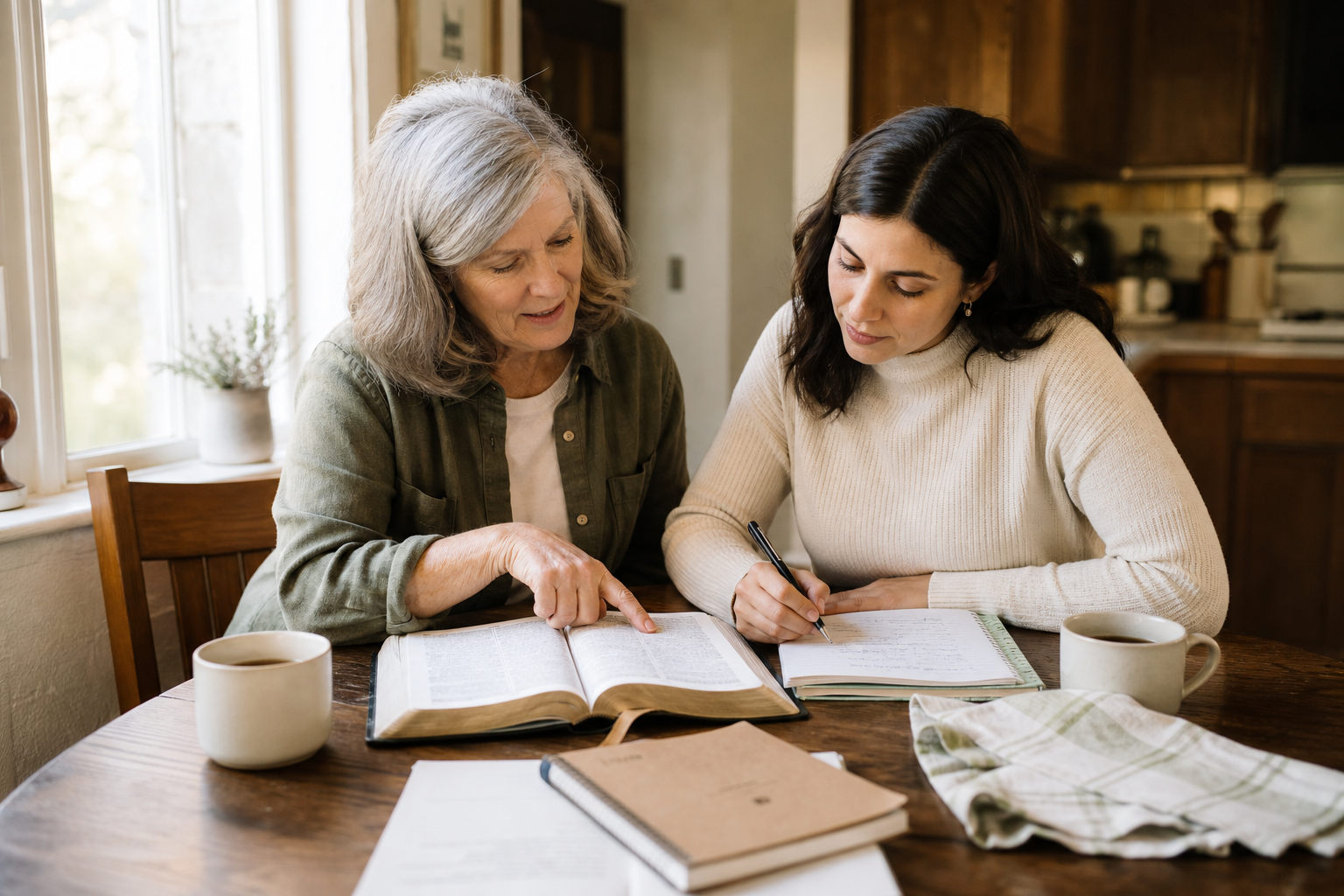
You can become the mother who apologizes, the grandmother who listens, the auntie who notices, the teacher who welcomes difficult questions, the mentor who refuses to hand her wounds to another woman and call them wisdom. You can become the woman whose kitchen table is a place where younger women discover they are allowed to think, ask, learn, fail, repent, grow, and open the Bible for themselves.
You cannot rewrite everything that was handed to you. But you can decide what you hand forward. That is generational work.
She Will Eventually Walk Into Rooms Without You
When she is little, your voice is everywhere. Put your shoes on. Brush your teeth. Stop hitting your sister. No, cereal is not dinner. Yes, you need pants to go to the grocery store. Again. Your voice surrounds her because for a while, that is what raising children requires.
Then life expands. School. Work. Friendships. Relationships. Marriage perhaps. Rooms you never enter. Conversations you never hear. Decisions you cannot supervise. And somewhere along the way, you realize that raising a girl was never ultimately about making certain she obeyed your voice forever. It was about helping her learn to recognize His.
One day she will leave the shelter of your voice and walk into rooms where you cannot tell her who she is. Teach her now to recognize the voice of Yehovah when yours is no longer beside her.
That changes parenting. It changes mentoring. It changes Titus 2. The goal is not to produce a thirty-year-old woman who cannot make a decision until Mom approves it. The goal is a woman who knows Scripture, knows Yehovah, recognizes wisdom, weighs counsel, listens to correction, detects manipulation, understands her responsibility, and can stand before her King with a clear conscience. At some point, your voice must become quieter. His must remain.
Before the World Tells Her
Maybe she is eight years old and sitting at your kitchen table coloring while you read your Bible. Maybe she is fourteen and entirely convinced nobody in the history of humanity has suffered as profoundly as a girl whose friend did not answer a text. Maybe she is twenty-two and sitting across from you trying to determine whether the man she loves is actually good for her. Maybe she is thirty-five and calling because motherhood is harder than she imagined. Maybe she is fifty and now she is the older woman.
This is how the Kingdom moves through generations. Not merely through pulpits, but through tables, car rides, gardens, text messages, prayers, apologies, recipes, Bible studies, difficult conversations, and ordinary afternoons where one woman quietly teaches another how to live.
A Titus 2 woman is not merely a woman with enough birthdays to qualify as older. She is a woman whose life has been surrendered long enough for wisdom to become something she can hand forward. She understands that the girl following her does not need to become her copy. She needs to become faithful.
So she teaches her enough about beauty to know it is not her worth, enough about attention to know desire is not love, enough about men to respect them without making their approval her god, enough about marriage to honor it without worshiping it, enough about motherhood to value it without believing it completes a woman, enough about work to become competent without measuring herself by achievement, enough about modesty to understand that it includes far more than clothing, enough about gentleness to remain soft without becoming helpless, and enough about respect to honor others without surrendering the personhood Yehovah gave her.
And above all, she teaches her the Scriptures. Because eventually every other voice will compete with that one.
Final Thought
There is a little girl somewhere learning what a woman is. Perhaps she is your daughter or granddaughter. Maybe your niece. Maybe a girl in your congregation whose mother is exhausted and doing the best she can. Maybe a teenager who has quietly begun watching you because something about your life feels steadier than the world around her.
You may never sit her down and formally announce, "I have decided to disciple you." Please don't. She may run. Just live close enough that she can see what faithfulness looks like. Let her see you open your Bible when you do not understand something. Let her see you admit when you are wrong. Let her watch you refuse gossip. Let her hear you speak about your body without contempt. Let her watch you celebrate another woman's success. Let her see you be strong without becoming hard and gentle without becoming helpless. Let her watch you honor men without worshiping them. Let her see you love your family deeply without making their dependence upon you the source of your identity.
Teach her to cook something and manage money. Teach her to work and to rest. Teach her to think, pray, ask questions, recognize manipulation, laugh at herself, apologize, say no, and begin again. Teach her that her value does not increase when someone finds her sexually attractive. Teach her that modesty is not hiding in shame but carrying herself - in dress, behavior, speech, attitude, and relationships - with dignity before Yehovah.
But more than anything, teach her whose she is. Because the world is going to speak. It will tell her she is too much or not enough, too loud or too quiet, too fat or too thin, too intelligent or insufficiently accomplished, too young until suddenly she is too old. It will call her desirable and tell her that is power, then call her invisible and suggest she has lost something. It will rename her every time culture changes its mind.
Do not wait until then to introduce her to the truth. Before the world tells her sexual attention determines her worth, teach her that she belongs to Yehovah. Before it tells her motherhood will complete her, teach her that the King already knows her name. Before it tells her achievement determines her value, teach her that faithfulness matters more than applause. Before someone uses Scripture to make her smaller, teach her how to open it herself. Before someone claims to speak for Yehovah, teach her to recognize His voice in what He has already spoken.
And when the day comes that she walks into a room where you cannot follow, she will carry something stronger than your instructions. She will carry truth. One day she will leave the shelter of your voice and walk into rooms where you cannot tell her who she is. Teach her now to recognize the voice of Yehovah when yours is no longer beside her.
Then when the world asks her to prove her worth, perhaps she will already know there is nothing to prove. She belongs to the King. And now she gets to spend her life learning what faithfulness to Him looks like. Don't take my word for it... Open your Bible.